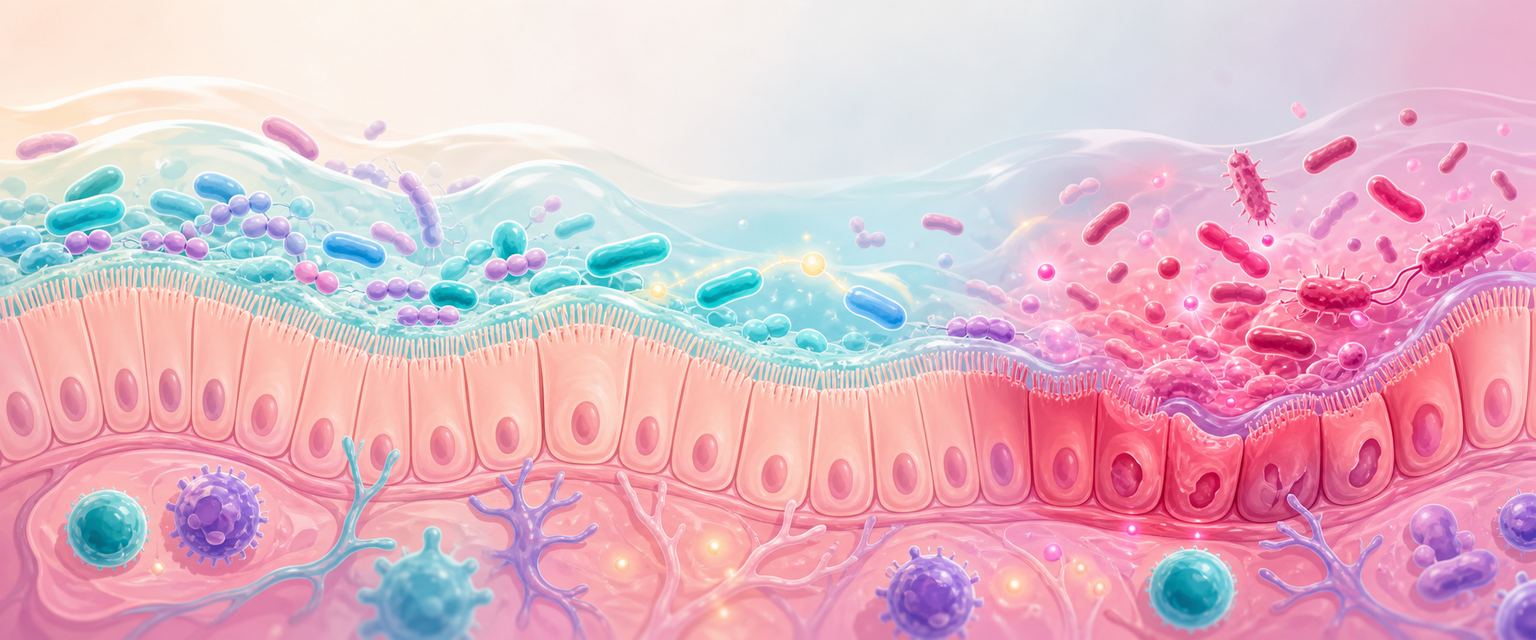
The One Idea That Organises This Chapter
Start from a single sentence and let everything else hang off it: a microbe is never simply "good" or "bad" — what it does to a patient is decided by the relationship it strikes with that host, at that site, at that moment. The same organism can be expected flora in one niche, harmless company in another, and lethal in a third. Escherichia coli in the colon is doing its job; in the bladder it causes a urinary tract infection (UTI); in the bloodstream after pyelonephritis it can drive sepsis. The organism did not change. The relationship did.
Hold that picture and microbiology in O&G stops being a memory test of organism names and becomes a single repeated question: what is this organism doing, in this site, to this host, at this time? A vaginal swab, a urine culture, a placental histology report, a blood culture — none of them means anything on its own. Each is interpreted through anatomy, the integrity of the epithelial barrier, the symptoms, the inflammatory evidence, the pregnancy state, the quality of the sample, and the cost of being wrong.
The cost runs in both directions. Treat a harmless coloniser as disease and you waste antibiotics, drive resistance and disturb the very community that was protecting your patient. Miss a real invasive infection and you get pelvic inflammatory disease (PID), puerperal sepsis, neonatal infection or a post-operative death. The Primary skill, again and again, is to classify the relationship before you treat the laboratory result. This chapter builds from that one idea: first the vocabulary it forces on us, then the spectrum a patient can slide along, then the levers that move them along it — virulence on the organism's side, barriers and immunity on the host's side — and finally how to read the specimen that lands on your desk.
The applied treatment pathways for discharge, PID and acute pelvic infection sit in the linked Intermediate and Final chapters. Here we stay with the mechanism.
The Vocabulary the One Idea Forces on Us
If the relationship is what matters, then we need precise words for the kinds of relationship a microbe can have with a host. These are not interchangeable, and examiners reward the candidate who reaches for the right one. Read this table as a ladder of possible relationships, not a list of fixed labels — most organisms can occupy several rows depending on context.
| Relationship | Meaning | O&G example |
|---|---|---|
| Commensalism | The microbe benefits; the host is not measurably harmed in that context | Coagulase-negative staphylococci on skin; many vaginal anaerobes at low abundance |
| Mutualism / symbiosis | Host and microbe both benefit | A lactobacillus-dominant vaginal ecosystem lowering pH and providing colonisation resistance |
| Pathogenicity | The microbe causes host damage | Neisseria gonorrhoeae cervicitis and PID; group A streptococcal puerperal sepsis |
| Opportunism | A usually low-harm organism causes disease after the host or site changes | Candida after antibiotics; E. coli ascending UTI; skin flora infecting a cannula |
| Dysbiosis | The community's function shifts toward disease, even with no single classic pathogen | Bacterial vaginosis (BV), with an anaerobe-rich biofilm and reduced lactobacillus dominance |
| Colonisation | An organism is present and multiplying without tissue invasion or symptoms | Group B streptococcus (GBS) carriage; asymptomatic Candida carriage |
| Contamination | An organism introduced during sampling or handling, not from the patient's disease | Skin flora in a poorly collected blood culture |
Two distinctions inside this table do most of the diagnostic work. The first is colonisation versus infection: mere isolation of an organism is not disease. The deciding factor is whether the organism is invading tissue and provoking host damage, or simply living on a surface. The second is the Dr Jekyll and Mr Hyde nature of most species: within one species there are usually harmless strains and dangerous strains. E. coli O157 is a feared gut pathogen; E. coli Nissle is sold as a probiotic — yet routine 16S ribosomal RNA sequencing cannot tell the two apart, because the resolution is too coarse. The species name is the beginning of interpretation, not the end of it.
The Host-Microbe Spectrum
These relationships are not fixed states. They sit on a spectrum, and the same patient can travel along it within hours if a barrier is breached, tissue becomes ischaemic, antibiotics remove competitors, or immunity changes. Build the picture as a continuum from least to most host involvement:
| State | Host response | Organism behaviour | Clinical action |
|---|---|---|---|
| Exposure | No established growth | Organism contacts a host surface | Usually no treatment; prevention may matter |
| Colonisation | Minimal tissue inflammation | Organism persists at a site | Treat only when the context makes carriage dangerous |
| Dysbiosis | Variable inflammation | Community function shifts | Treat the syndrome and reduce the recurrence drivers |
| Local infection | Tissue inflammation and symptoms | Invasion or toxin effect at a site | Site-specific diagnosis and treatment |
| Invasive infection | Systemic response possible | Organism reaches sterile tissue or blood | Urgent therapy, cultures and source control |
| Sepsis | A dysregulated host response with organ dysfunction | Infection drives systemic harm | Resuscitation, antibiotics and source control |
This spectrum is the reason a single positive result can demand reassurance, a repeat collection, targeted treatment, partner management, isolation, public-health notification or emergency sepsis care — entirely depending on context. In Primary, the correct answer almost always begins with classification, and management follows from where on the spectrum the patient actually sits.
What Decides Where a Patient Sits: Context
Microbial disease is the result of host damage, not simply organism presence. So the question becomes: what context shifts move a patient rightward along the spectrum, from coloniser to invader? Each row below is a lever you will recognise repeatedly on the labour ward, in theatre and in the gynaecology clinic.
| Context shift | Microbiological effect | O&G consequence |
|---|---|---|
| Barrier breach | Flora gain access to sterile or deep tissue | Caesarean wound infection, postpartum endometritis, perineal wound sepsis |
| Site transfer | A commensal enters a vulnerable site | Bowel flora causing UTI after catheterisation |
| Foreign material | Surfaces for adhesion and biofilm; the infective dose drops sharply | Catheter-associated UTI, suture sinus, persistent device infection |
| Antibiotic exposure | Competitors removed; resistant organisms selected | Candida overgrowth, recurrent BV patterns, resistant Gram-negative colonisation |
| Immunosuppression | Containment fails | HIV-associated HPV persistence, TB, severe Candida, atypical presentations |
| Pregnancy / puerperium | Altered immunity, genital-tract exposure, a placental-bed wound | Higher influenza severity, pyelonephritis risk, puerperal sepsis |
| High inoculum | Host defences overwhelmed | Chorioamnionitis after prolonged rupture and repeated examinations |
| Necrotic tissue or blood clot | A nutrient-rich, poorly perfused focus | Retained products, infected haematoma, septic abortion |
This is why "mixed flora" can be normal in a low vaginal swab but dangerous in an abscess; why repeated vaginal examinations after ruptured membranes raise the ascending-infection risk; and why retained products can stay septic despite apparently appropriate antibiotics. The next two sections take the two most exam-relevant levers — inoculum and foreign material, and the disrupted ecology — and explain the mechanism behind them.
Inoculum, Foreign Material and the Damage Pathway
A microbe only becomes clinically important when it can complete enough steps in a sequence from being present to causing damage. This framework is your friend when a stem gives you a confusing culture result and asks what it means.