In one line
Placenta accreta spectrum (PAS) is iatrogenic disease — abnormal trophoblast invasion through the defective decidua of a previous caesarean scar — and the patient's life is decided antenatally, by diagnosing it before labour, delivering her in a centre with a multidisciplinary team and a massive-transfusion service at around 34–36 weeks, and performing a planned caesarean-hysterectomy that never disturbs the placenta; the complicated caesarean more broadly is the same discipline applied to dense adhesions, the deeply impacted or transverse-lying fetus, and the unplanned haemorrhage.
Mechanism & pathophysiology
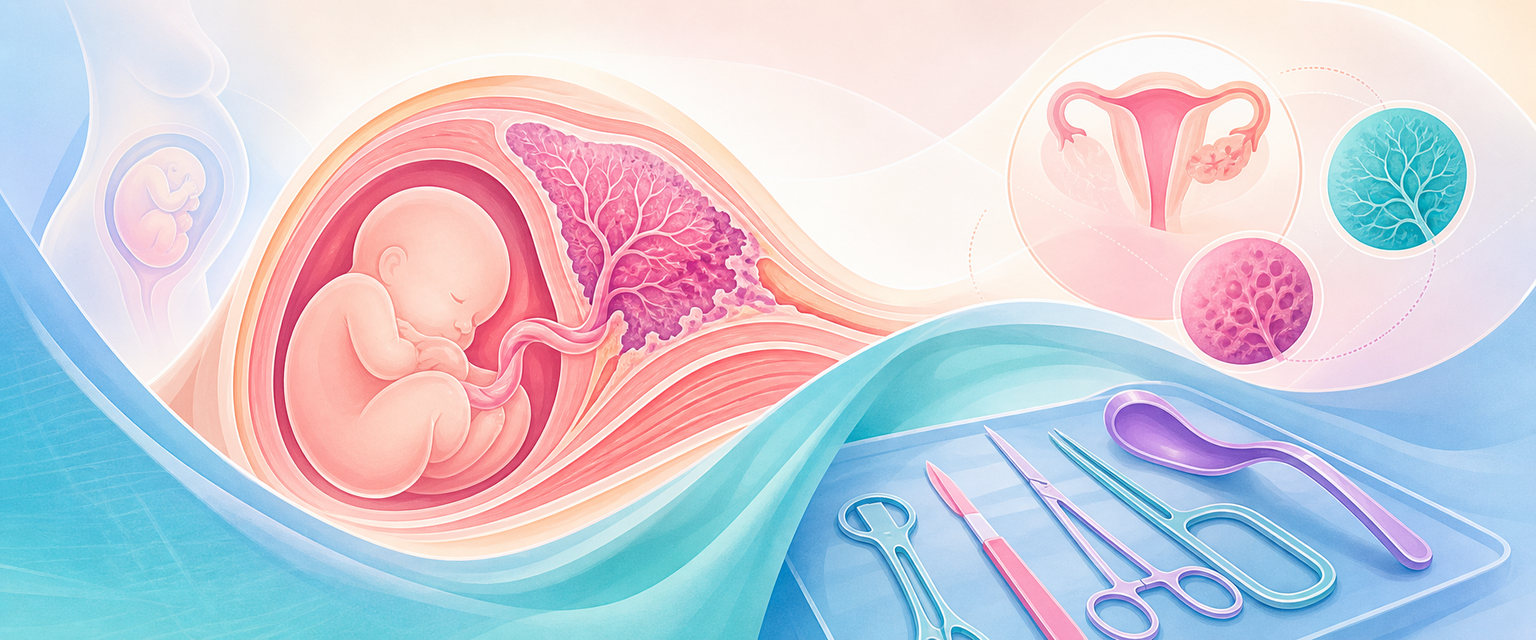
The accreta spectrum is a defect of the maternal–fetal interface, not of the trophoblast itself. Normal implantation places anchoring villi against decidua basalis, a specialised endometrial layer that limits how deeply extravillous trophoblast invades and that later provides the cleavage plane through which the placenta separates. Where a previous caesarean has left a scar, the endometrium and superficial myometrium over that scar heal by fibrosis with absent or deficient decidua. A subsequent blastocyst implanting low and anteriorly — over the scar — meets no decidual barrier, so extravillous trophoblast and anchoring villi invade unchecked into and through the myometrium. The favoured model, set out in the ACOG/SMFM consensus, is precisely this: a defect of the endometrial–myometrial interface causes failed decidualisation in the area of a uterine scar, allowing abnormally deep anchoring villi and trophoblast infiltration. It is therefore a wound-healing disease, and the strongest single predictor is the number of previous uterine scars.
Depth of invasion defines the FIGO grades. In accreta (FIGO grade 1) villi adhere directly to myometrium without intervening decidua but do not invade it; in increta (grade 2) villi invade into the myometrium; in percreta (grade 3) they breach the serosa (3a) and may invade the bladder (3b) or other pelvic organs (3c). The clinical danger scales with depth because the abnormal placental bed recruits a florid, high-flow neovasculature — dilated subplacental and uterovesical vessels with disordered architecture — so that any attempt to separate the placenta opens vessels that cannot contract down, and exsanguinating haemorrhage follows within minutes. The histological reality at the time of surgery is that there is no separation plane to find: the placenta and myometrium are one continuous, engorged mass, which is why the entire operative strategy is built around not looking for a plane that does not exist. The depth is also not uniform — a placenta may be accreta over most of its bed and increta or focally percreta at one point, so the worst area dictates the plan.
The accuracy of depth assessment matters because it changes the operation, not just the label: a focal accreta over the scar in a woman who has completed her family is managed differently from a percreta invading the bladder dome, where urology must be scrubbed and the bladder dome may be deliberately resected with the specimen. The disordered uterovesical neovasculature of percreta is the single most dangerous anatomy in obstetric surgery — large, thin-walled, high-pressure vessels running between an invaded bladder and the uterus, with no surgical plane and no capacity to constrict — and underestimating it preoperatively is the commonest route to an uncontrolled loss of several litres in minutes.
Praevia is the co-conspirator, and the synergy with prior caesarean is the number to know. A placenta is praevia when it covers or encroaches on the internal os; the low-lying placenta is far more likely to overlie a scar, and praevia and accreta share the same risk factor. Silver's prospective cohort of women with praevia quantified the interaction exactly: the risk of accreta in a woman with praevia rises from 3% with no prior caesarean to 11%, 40%, 61% and 67% with one, two, three and four or more previous caesareans. The lesson is that praevia in a scarred uterus is accreta until imaging proves otherwise, and the third or fourth repeat caesarean with an anterior low placenta is the archetypal high-risk patient. The same biology underlies the caesarean-scar pregnancy — implantation within the scar niche itself — which is the early-gestation precursor of percreta and should be managed as such rather than as an ordinary low miscarriage.
Assessment
Risk stratification begins before any scan, from the obstetric history.
- Count the scars and place the placenta. The two variables that drive risk are the number of prior caesareans and an anterior placenta praevia or low-lying placenta overlying the scar. A single risk factor (one prior CS, posterior praevia) is low risk; their combination — an anterior praevia in a woman with two or more previous caesareans — is the high-probability accreta until disproved.
- Other scarred-uterus risk factors add to the picture: previous myomectomy entering the cavity, prior uterine curettage or endometrial ablation, manual removal of placenta, Asherman treatment, and increasing maternal age and parity. PAS can occur without any prior surgery, but uncommonly.
Ultrasound is the first-line diagnostic test, and a focused greyscale plus colour-Doppler examination by an experienced operator is as accurate as MRI for most cases. The greyscale signs to seek are: loss of the normal hypoechoic retroplacental clear (myometrial) zone; multiple irregular vascular lacunae ("Swiss-cheese" or "moth-eaten" placenta), the single most useful sign; thinning or interruption of the hyperechoic uterine serosa–bladder wall interface; and focal exophytic placental tissue bulging beyond the serosa. Colour Doppler adds turbulent high-velocity lacunar flow, abnormal subplacental hypervascularity, and bridging vessels crossing the placenta–myometrium–bladder plane. The accreta workup is therefore done at the time of the routine anomaly scan whenever the placenta is low and anterior with a prior scar — it is a deliberate, directed examination, not an incidental finding.
MRI is the adjunct, not the screening tool. It earns its place where ultrasound is equivocal, where the placenta is posterior (poorly seen on transabdominal/transvaginal ultrasound), and where defining the topography and depth of invasion changes the surgical plan — parametrial extension, lateral or posterior bladder involvement, ureteric proximity. The MRI features of invasion are dark intraplacental bands on T2, uterine bulging, heterogeneous placental signal, focal myometrial interruption, and tenting of the bladder. MRI does not improve the basic accreta-versus-no-accreta decision over good ultrasound; it informs the operative decision in advanced disease.
- Grade the praevia and document the lower-segment anatomy. Whether the placenta covers the os, the distance from the leading edge to the os, and the position relative to the scar all shape the hysterotomy plan (the incision must avoid the placenta).
- Baseline investigations stage the host as well as the placenta: full blood count and ferritin (correct anaemia before the operating list, not on the table), group-and-save with antibody screen and crossmatched units arranged ahead of time, coagulation, U&E/creatinine, and an HIV test with confirmation of suppressive antiretroviral therapy — antenatal anaemia and limited blood-product availability are the SA-specific multipliers of accreta mortality, and both are correctable in clinic.
- Cystoscopy is considered where percreta with bladder invasion is suspected, to plan urological involvement.
The South African reality reshapes this assessment in two ways. First, the rising caesarean rate is steadily enlarging the at-risk population — every primary caesarean that becomes a repeat, and every repeat that follows, adds scars and raises the next pregnancy's accreta risk, so the population-level driver of PAS is the same driver of so much else in the Saving Mothers data. Second, the practical failures cluster around late or absent diagnosis: a woman who books late, who has no detailed placental localisation, or who is delivered at a district facility without the imaging or the referral pathway, presents not as a planned accreta case but as an unexpected catastrophe in a theatre without blood. The corollary is that the most valuable thing a clinician can do for accreta mortality in South Africa happens in the antenatal clinic — identify the scarred uterus with a low anterior placenta, do the directed scan, and refer up the district→regional→tertiary chain in time for a planned delivery where blood products and an MDT exist.
Management
Order the plan immediate → ongoing → long-term, and the decision that determines survival is made weeks before delivery: a woman with antenatally diagnosed PAS belongs in a specialist centre, on a planned list, with the whole team assembled — not delivered as an emergency by whoever is on call when she bleeds.
| Decision | The plan | Why |
|---|---|---|
| Where | PAS / accreta centre, level III–IV, with MDT + on-site blood bank | Eller: MDT care cut composite morbidity (adjusted OR 0.22) |
| When | Scheduled ~34–36 weeks with antenatal corticosteroids | Robinson–Grobman: 34 wk maximised outcome; OCC No.7 34⁰–35⁶ |
| Incision | Avoid the placenta — classical/fundal or high transverse hysterotomy | Cutting through an accreta opens catastrophic bleeding |
| Placenta | Leave it in situ; do not attempt removal | Eller: removal attempt doubled early morbidity |
| Definitive | Planned caesarean-hysterectomy (placenta left attached) | The reference-standard approach in scarred-uterus PAS |
| Conservative | Leave-in-situ / expectant, selected fertility-desiring cases only | Sentilhes: fertility preserved but ~29% recurrence, real morbidity |
Immediate — the planned PAS caesarean-hysterectomy
The operation is choreographed in advance. Antenatal corticosteroids are given for the planned late-preterm delivery. Senior obstetrician(s), an experienced anaesthetist (the case is usually done under general or combined regional–general anaesthesia with large-bore venous access and an arterial line), urology or gynae-oncology where bladder involvement is anticipated, and a primed massive obstetric haemorrhage pathway with crossmatched blood, fibrinogen/cryoprecipitate, tranexamic acid and a cell-salvage machine are all in the room before the skin incision.
The anaesthetic conduct is part of the surgical plan. Many centres begin under regional anaesthesia for delivery of the baby and convert to general anaesthesia for the hysterectomy, or use a combined technique from the outset; what matters is two large-bore cannulae, an arterial line, a warmed theatre, fluid warmers and a rapid infuser, and a massive obstetric haemorrhage pathway activated before the loss rather than in response to it. Transfuse early and in a fixed ratio (red cells with fresh frozen plasma and platelets), give tranexamic acid early, and guide ongoing replacement of fibrinogen and platelets by point-of-care viscoelastic testing where available — the coagulopathy of PAS is dilutional and consumptive and develops fast once a few litres have been lost. The principle is anticipation: blood is in the room, the protocol is running, and the team is not improvising under pressure.
Surgical principles:
- Map the placenta and choose a hysterotomy that avoids it. With an anterior placenta covering the lower segment, the fetus is delivered through a classical (vertical) or fundal incision, or a high transverse incision above the upper placental edge. Cutting through accreta tissue to reach the fetus provokes the haemorrhage the whole plan exists to prevent.
- Deliver the baby, clamp and cut the cord short, and do NOT touch the placenta. Leaving it completely undisturbed and proceeding directly to hysterectomy is the manoeuvre that most reduces blood loss. Eller's data are explicit: scheduled caesarean-hysterectomy without attempting placental removal had roughly half the early morbidity of cases where removal was attempted.
- Control inflow, then perform hysterectomy. The hysterectomy is technically harder than a routine one because of the engorged, friable lower-segment and uterovesical neovasculature and the distorted, often densely adherent bladder; it proceeds methodically from the round ligaments downward, securing the highly vascular pedicles, with deliberate, unhurried dissection of the bladder off the lower segment.
- Adjuncts to reduce inflow: preoperative ureteric stents make the ureters palpable and lower the rate of urological injury and early morbidity (Eller); interventional-radiology balloon occlusion of the internal iliac/aorta or prophylactic uterine artery embolisation can reduce blood loss where the service exists, accepting the logistics and the radiation/thrombosis risks. Hypogastric (internal iliac) artery ligation does not reliably reduce blood loss and should not be relied upon — the pelvic collateral circulation is too rich, and Eller found no morbidity benefit from it.
- Cell salvage is endorsed as safe in obstetric haemorrhage when used with a leucocyte-depletion filter (and anti-D for the rhesus-negative woman receiving salvaged fetal-contaminated blood), and is particularly valuable where banked blood is scarce.
- Bladder/ureteric involvement (percreta). With bladder invasion (FIGO 3b), the safest course is often not to dissect the placenta off the bladder but to resect the involved bladder dome with the specimen and repair it, with urology present; forcing a plane that does not exist tears the trigone and the engorged uterovesical vessels together. Ureteric stents and a deliberate, anatomy-led dissection protect the ureters.
Conservative and uterus-sparing options — and their honest limits
Leaving the placenta in situ (expectant/conservative management) — delivering the baby, leaving the placenta attached, closing the uterus and allowing the placenta to resorb or be resected later — preserves the uterus and is reserved for carefully selected, fully counselled women who place a high value on future fertility, managed in a centre that can deal with the delayed haemorrhage, sepsis and need for secondary hysterectomy that some will develop. The French national series under Sentilhes showed that successful conservative treatment does not compromise later fertility — most women wanting another pregnancy conceived and delivered healthy babies — but it also showed that accreta recurred in about 29% of subsequent pregnancies, and the companion cohort recorded severe maternal morbidity including sepsis in a minority. Methotrexate to "dissolve" the retained placenta is not supported — the placenta is not metabolically dividing trophoblast at term, the drug adds toxicity without clear benefit, and current guidance has abandoned it. Interventional radiology (UAE) and serial imaging or β-hCG monitoring support the conservative pathway where it is chosen. Conservative management is a deliberate, consented trade of immediate certainty for future fertility — not a default, and not a substitute for an unplanned, under-resourced caesarean-hysterectomy that should have been planned.
The unexpected accreta and the difficult caesarean
Not every accreta is diagnosed antenatally, and the broader objective is the complicated caesarean in all its forms. The governing rule when an undiagnosed accreta is encountered at caesarean is recognise, do not provoke, and call for help: if the placenta will not separate and an accreta is suspected, stop — do not keep pulling on a placenta that will not come — close the uterus with the placenta in situ if the patient is stable, summon senior obstetric, anaesthetic and blood-bank support, and either proceed to hysterectomy with the assembled team or stabilise and transfer. Persisting with piecemeal manual removal in a district theatre, without blood, is the mechanism of an avoidable maternal death.
The technically difficult caesarean shares the same need for preparation:
- Dense adhesions from prior surgery. A scarred lower segment and a bladder adherent high on the uterus turn entry into the slowest, most dangerous part of the operation. Enter deliberately, develop the bladder flap sharply under direct vision, and accept that the bladder lies higher than expected — cystotomy from blunt sweeping is the classic injury.
- Choosing the uterine incision. A low transverse incision is the default, but the classical (vertical upper-segment) or De Lee (low vertical) incision is the right choice when the lower segment is unformed (very preterm, transverse lie with the back down), is occupied by a large lower-segment fibroid, is the site of an anterior placenta praevia/accreta, or when a constriction ring or extensive adhesions make a transverse incision unsafe. The trade-off is a vertical scar that mandates elective repeat caesarean and carries a higher rupture risk in any future pregnancy — counsel her accordingly.
- The impacted, deeply engaged head at a second-stage caesarean, and the manoeuvres to disimpact it — the vaginal push versus reverse breech (Patwardhan) extraction — are the substance of caesarean-at-full-dilatation; the same judgement (recognise the impacted head, choose the technique that minimises uterine extension) applies whenever the head is jammed in the pelvis at delivery.
- Transverse lie / malpresentation. With a back-down transverse lie and an unformed lower segment, internal podalic version to grasp a foot and deliver as a breech, often through a vertical incision, avoids a difficult and traumatic extraction; a low transverse incision over a shoulder presentation risks a T-extension into the uterine vessels.
- The haemorrhage drill is the same currency across all of these. Uterotonics, tranexamic acid, mechanical and compression measures, and escalation to balloon tamponade, compression sutures, devascularisation and hysterectomy follow the structured pathway set out in postpartum-haemorrhage; the rare but catastrophic intraoperative scenario of uterine-rupture demands the same readiness.
Ongoing and long-term
After a caesarean-hysterectomy: high-dependency care, continued correction of coagulopathy guided by point-of-care testing, vigilance for ongoing pelvic or retroperitoneal bleeding and for urological injury, venous thromboembolism prophylaxis once haemostasis is secure, and early recognition of the psychological impact of an emergency hysterectomy and the loss of fertility. Optimise the HIV-positive woman's antiretroviral therapy throughout (the SA framing is PVT-era HIV care). Counsel explicitly that the disease is a consequence of repeated uterine surgery — contraception and, where childbearing is complete, the avoidance of further caesareans are part of preventing the next case, in this woman's family and in the service.
Guidelines compared
The major bodies agree on the architecture — antenatal diagnosis, specialist-centre delivery, planned caesarean-hysterectomy with the placenta undisturbed — and differ mainly in emphasis and in the exact timing window.
| Body | Diagnosis | Timing | Surgical default | Notable emphasis |
|---|---|---|---|---|
| RCOG GTG 27a (2019) | USS first-line; MRI adjunct for depth/posterior placenta | Planned late-preterm in a specialist centre | Caesarean-hysterectomy, placenta in situ | Cell salvage, IR, MDT, antenatal pathway |
| FIGO (2019) | Standardised clinical grading 1–3 (accreta/increta/percreta) | — (classification document) | — | Common reporting language for outcomes/research |
| ACOG/SMFM OCC No. 7 (2018) | Clinical risk factors weighted equally with USS | 34⁰–35⁶ weeks | Caesarean-hysterectomy, placenta left in situ | Level III/IV centre, massive-transfusion infrastructure |
| SA NDoH (Saving Mothers context) | Antenatal detection + referral up the district→regional→tertiary chain | Plan at the tertiary centre with blood available | Caesarean-hysterectomy at the referral centre | The system problem is late/undiagnosed presentation, anaemia, blood supply |
The substantive divergences are narrow. ACOG/SMFM put a firm window (34⁰–35⁶ weeks) on timing; RCOG keeps it "planned late-preterm" without a single fixed week, recognising that a stable, asymptomatic woman may be delivered slightly later and a bleeding one earlier. FIGO is a classification, not a management guideline — its contribution is a shared grading language so that cohorts and trials can be compared. The South African layer is organisational rather than technical: the guidance is the same, but the recurring failure is a woman with undiagnosed accreta presenting in labour or with antepartum haemorrhage at a facility without an MDT or an adequate blood bank, which is why antenatal diagnosis and timely referral are the SA-specific interventions that change outcomes most.
The evidence & the controversy
The evidence base for PAS is honest about what it is: observational cohorts, decision modelling and expert consensus, with no randomised trial of caesarean-hysterectomy versus conservative management — such a trial would be neither ethical nor feasible. That shapes how the literature is argued. The strongest causal claim is preventive and epidemiological: Silver's cohort tied accreta risk directly to the number of prior caesareans, so the rising caesarean rate is the engine of a rising accreta incidence, and this is the one place where the data point at a population-level intervention (safe reduction of primary and repeat caesareans) rather than a surgical one.
The central management evidence is Eller's Utah work. The 2009 paper established the operative principles — scheduled caesarean-hysterectomy without attempting placental removal, and preoperative ureteric stents, both reduced early morbidity, while hypogastric artery ligation did not — and the 2011 paper showed that delivering these patients through a multidisciplinary team in a tertiary centre roughly quartered the odds of composite early morbidity (adjusted OR 0.22). These are retrospective cohorts, vulnerable to selection (the MDT centres also chose which cases to take), but the effect size, the biological plausibility and the consistency with every subsequent series make "diagnose antenatally and deliver in an accreta centre" the least controversial high-value intervention in the whole topic. Robinson and Grobman's decision analysis supplies the timing answer — 34 weeks maximised quality-adjusted outcome, and amniocentesis for lung maturity added nothing — which fed the guideline windows.
Two genuine controversies remain live. The first is timing: the modelled and guideline-endorsed 34–36-week window is being pressed later by recent cohort data suggesting that, in stable women without bleeding managed in expert centres, planned delivery can be deferred towards term to improve neonatal outcomes without measurably worsening maternal ones. This is not yet a guideline change and depends entirely on a level of antenatal surveillance and rapid theatre access that a stable, asymptomatic woman in a resource-limited setting cannot be guaranteed — so the defensible position is the 34–36-week plan as the standard, with later delivery only in a centre that can respond instantly to bleeding. The second is conservative versus radical surgery: leave-in-situ management preserves fertility (Sentilhes) but trades it for delayed haemorrhage, sepsis, secondary hysterectomy and a ~29% recurrence rate, so it remains a selected, consented option rather than a default, and the discredited routine of methotrexate to involute a retained term placenta should be named as obsolete. The honest summary is that the field is consensus-led, the one robust population lever is preventing unnecessary caesareans, and the one robust clinical lever is antenatal diagnosis plus centralised, team-based, placenta-undisturbed surgery.
Landmark trials & key evidence
| Trial / study (year) | Question | Key finding | What it changed |
|---|---|---|---|
| Silver et al. (2006) | Morbidity by number of repeat caesareans | Accreta with praevia 3→11→40→61→67% for 0–4+ prior CS; accreta, hysterectomy, injury all rise with CS number | Quantified the prior-CS + praevia synergy; the risk-stratification numbers |
| Eller et al. (2009) | Which operative strategies reduce morbidity? | Scheduled caesarean-hysterectomy without placental removal (36% vs 67% morbidity) + ureteric stents (18% vs 55%) helped; hypogastric ligation did not | Established "don't disturb the placenta", pro-stents, anti-routine-ligation |
| Eller et al. (2011) | MDT vs standard obstetric care | Composite early morbidity 47% vs 74%, adjusted OR 0.22 (0.07–0.70); less large-volume transfusion and reoperation | Centralised, team-based care in an accreta centre |
| Robinson & Grobman (2010) | Optimal delivery timing | Scheduled delivery at 34 weeks maximised QALYs; amniocentesis for lung maturity added nothing | The 34-week timing basis adopted by guidelines |
| Sentilhes et al. (2010) | Fertility after conservative (leave-in-situ) treatment | Fertility/obstetric outcome preserved; accreta recurred ~29% of next pregnancies | Conservative care is fertility-sparing but high-recurrence — selected cases only |
| ACOG/SMFM Obstetric Care Consensus No. 7 (2018) | How should PAS be managed? | Defect of endometrial–myometrial interface; deliver at level III/IV centre 34⁰–35⁶ wk; caesarean-hysterectomy, placenta in situ | Consensus management standard |
| RCOG Green-top Guideline No. 27a — Jauniaux et al. (2019) | Diagnosis & management of praevia and accreta | USS first-line, MRI adjunct; specialist-centre MDT; cell salvage/IR | UK standard of care |
| FIGO classification — Jauniaux et al. (2019) | A common grading system | Grade 1 accreta / 2 increta / 3 percreta (3a serosa, 3b bladder, 3c other) | Standardised reporting for research and audit |
| Gebhardt et al. — Saving Mothers / NCCEMD (2015) | Maternal death and caesarean section in SA | Death from CS ~3× vaginal delivery; praevia/accreta among CS-haemorrhage deaths; worse where CS rate is low | The SA system context — rising CS, late presentation, blood supply |
A worked figure from Silver makes the counselling concrete: a woman planning a fourth caesarean who has an anterior praevia carries a 61% risk of accreta — better than evens that this delivery becomes a caesarean-hysterectomy — which is the quantitative spine of the "every prior caesarean raises the stakes of the next" conversation, and of the argument for not performing a non-indicated primary caesarean in the first place.
Exam traps & red flags
- Disturbing the placenta. Attempting to remove a placenta accreta — or cutting through it to deliver the baby — is the central error; it converts a controlled operation into exsanguination. Leave it in situ and proceed to planned hysterectomy.
- Missing the antenatal diagnosis. Praevia in a scarred uterus is accreta until imaging excludes it; a low anterior placenta with two or more prior caesareans demands a directed accreta ultrasound, not reassurance.
- Delivering in the wrong place. A diagnosed accreta delivered at a district theatre without an MDT and blood bank, instead of being referred to a centre, is an avoidable death — the SA recurrent failure.
- Relying on hypogastric artery ligation. The pelvic collateral supply defeats it; it does not reliably reduce blood loss (Eller). Plan inflow control by ureteric stents and, where available, IR balloon occlusion — and be ready to proceed straight to hysterectomy.
- Methotrexate for a retained accreta placenta. Obsolete — the term placenta is not dividing trophoblast; it adds toxicity, not benefit.
- Choosing the wrong hysterotomy. A low transverse incision through an anterior accreta, or over a back-down transverse lie in an unformed lower segment, invites torrential bleeding or a T-extension; a classical or fundal incision that avoids the placenta is correct here.
- Forcing a bladder plane in percreta. Dissecting placenta off an invaded bladder tears the trigone and uterovesical vessels together; resect the involved bladder dome with urology rather than chase a non-existent plane.
- Operating on an unprepared, anaemic woman. Antenatal anaemia and unbooked blood are correctable in clinic; arriving in theatre without crossmatched units and a corrected haemoglobin multiplies mortality.
- Treating conservative management as a soft default. It is a consented, selected, fertility-driven choice with ~29% recurrence and real delayed morbidity — not the easy way out of a difficult operation.
- The undiagnosed accreta at caesarean. If the placenta will not separate, stop pulling, close over it if stable, and summon the team and blood — do not persist with piecemeal removal.
Evidence anchors
- Silver RM et al. — Maternal morbidity with multiple repeat cesarean deliveries, Obstet Gynecol 2006
- Eller AG et al. — Optimal management strategies for placenta accreta, BJOG 2009
- Eller AG et al. — Multidisciplinary care team vs standard care, Obstet Gynecol 2011
- Robinson BK, Grobman WA — Timing of delivery in praevia and accreta, Obstet Gynecol 2010
- Sentilhes L et al. — Fertility after conservative treatment for placenta accreta, Hum Reprod 2010
- ACOG/SMFM Obstetric Care Consensus No. 7 — Placenta Accreta Spectrum, Obstet Gynecol 2018
- RCOG Green-top Guideline No. 27a — Jauniaux et al., Placenta Praevia and Placenta Accreta, BJOG 2019
- FIGO classification for clinical diagnosis of PAS — Jauniaux et al., Int J Gynaecol Obstet 2019
- Gebhardt GS et al. — Maternal death and caesarean section in South Africa (Saving Mothers 2011–2013), S Afr Med J 2015
- South Africa NDoH National Committee for Confidential Enquiries into Maternal Deaths (NCCEMD), Saving Mothers reports — obstetric haemorrhage and caesarean-related death, referral and blood-product availability in the district→regional→tertiary system.
