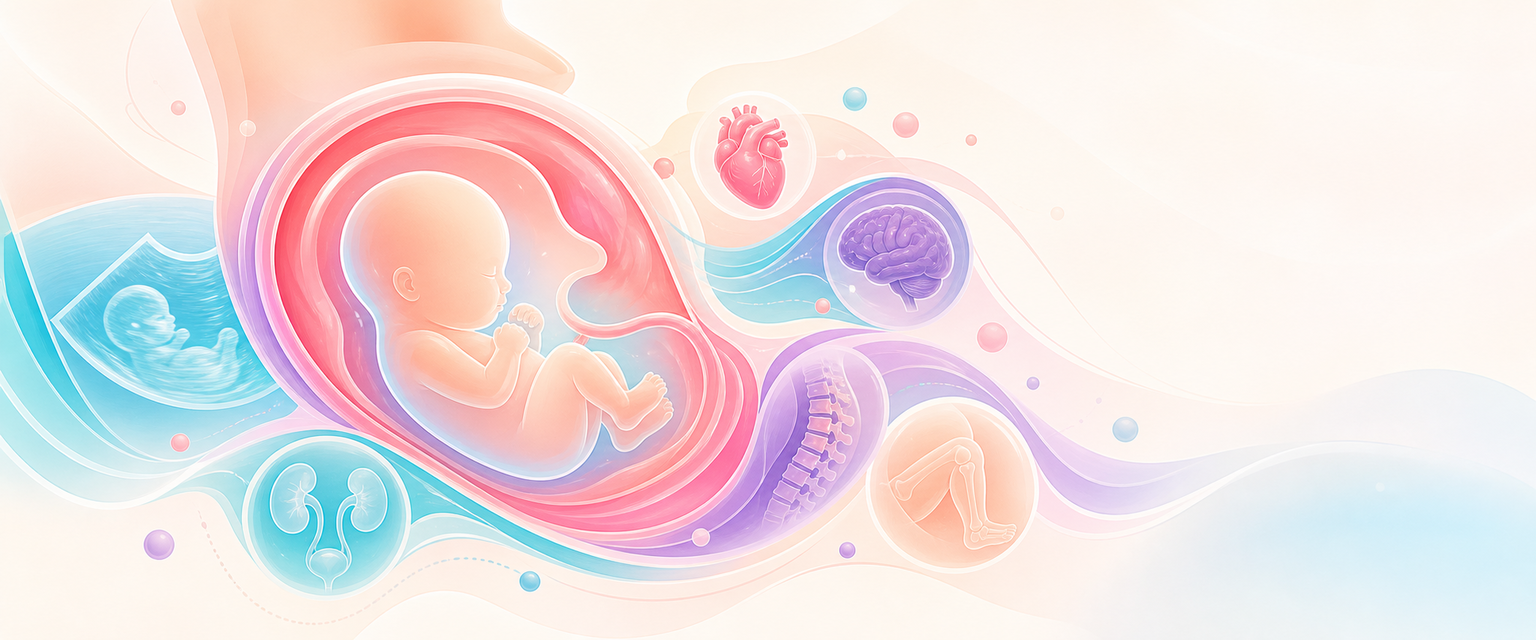
In one line
A major fetal structural anomaly is a diagnosis made on ultrasound that demands three separate consultant judgements — what it is, what it means for this baby, and what this woman wants done about it — and the single principle that organises all of them is that accurate characterisation (lethal vs survivable, isolated vs syndromic, operable vs not) must precede any counselling, because the prognosis you give determines the choice she is allowed to make.
Mechanism & pathophysiology
Structural anomalies arise when a developmental programme is interrupted, and the timing of the insult predicts the lesion more reliably than its cause. Most major malformations are written before the woman knows the gestation she will eventually be scanned at — which is why the 18–22-week scan is a record of embryology already completed, not a window onto a process you can still influence.
Neural-tube defects are the cleanest example. The neural plate folds and the neural tube closes between days 22 and 28 post-conception — before six menstrual weeks. Failure of cranial closure gives anencephaly (no calvarium, no functioning forebrain — uniformly lethal); failure of caudal closure gives open spina bifida (myelomeningocele), in which exposed neural tissue is damaged both by the primary defect and by a "second hit" of chronic chemical and mechanical injury from amniotic fluid across the rest of pregnancy. That second-hit model is the entire rationale for in-utero repair: close the defect before the cord finishes being destroyed. Open NTDs also drive cerebrospinal-fluid leak that collapses the posterior fossa and pulls the hindbrain down through the foramen magnum — the Chiari II malformation — which is what produces the ventriculomegaly and the "lemon" and "banana" cranial signs that flag the spine long before you see the spine itself. Folate's role is upstream of all of this: it supports the one-carbon methylation that the closing neuroepithelium depends on, which is why periconceptional folate, started before closure, prevents the defect and folate started at booking does nothing.
Congenital heart disease is the commonest serious anomaly group (roughly 6–8 per 1000 births) and the most frequently missed, because the four-chamber view that screening relies on is normal in the very lesions that kill early — transposition, coarctation, interrupted arch — where the abnormality is in the outflow tracts and great-vessel connections. The cardiac neural crest and the looping and septation of the primitive heart tube happen across weeks 4–8; a disturbance there (often with a genetic substrate — 22q11.2 deletion behind conotruncal lesions, trisomies behind atrioventricular septal defects) yields a structurally fixed heart by the time it can be imaged. The functional grouping that matters for delivery planning is whether the circulation is duct-dependent: lesions like transposition, critical coarctation, hypoplastic left heart and pulmonary atresia keep the neonate alive only while the arterial duct stays open, so they must be delivered where prostaglandin can be started and a paediatric cardiac service reached — the antenatal diagnosis is what buys that preparation, which is the whole point of looking for CHD before birth.
Twin–twin transfusion syndrome is the one "structural" lesion of the placenta rather than the fetus, and it belongs here because it is the commonest fetal-therapy referral and the lesion behind one of the field's defining trials. In a monochorionic twin pregnancy, unbalanced flow across shared placental vascular anastomoses creates a hypovolaemic, oliguric, oligohydramniotic donor and a hypervolaemic, polyuric, polyhydramniotic recipient at risk of cardiac failure and hydrops. Untreated severe TTTS before viability is largely lethal for both twins; the rationale for fetoscopic laser is to coagulate the communicating vessels and convert one shared circulation into two separate ones, which is why laser treats the cause and amnioreduction only the symptom.
Congenital diaphragmatic hernia is a failure of the pleuroperitoneal membrane to close by week 10, letting abdominal viscera herniate into the chest. The hernia itself is rarely the problem; the lethal lesion is the pulmonary hypoplasia and pulmonary vascular maldevelopment caused by lung compression during the canalicular and saccular phases. Prognosis therefore tracks lung volume, not hernia size — which is the conceptual key to fetal therapy for CDH.
Abdominal-wall defects separate on embryology into two diseases that look superficially similar and behave oppositely. Gastroschisis is a paraumbilical (almost always right-sided) defect with no covering membrane — free loops of bowel exposed to amniotic fluid; it is a vascular/disruptive event, usually isolated, with a low aneuploidy rate but a real risk of bowel injury, and its epidemiology is strikingly young-maternal-age and rising. Exomphalos (omphalocele) is a midline defect with the herniated viscera covered by a peritoneal-amniotic membrane and the cord inserting on the sac — a failure of physiological midgut return, with a high rate of associated chromosomal and syndromic disease (trisomies 13/18, Beckwith–Wiedemann). The membrane is the discriminator that should reorganise the whole workup: its presence raises the karyotype and cardiac stakes.
Renal-tract anomalies span a spectrum from lethal to incidental. Bilateral renal agenesis or bilateral multicystic dysplasia produces anhydramnios from mid-pregnancy and, through it, the pulmonary hypoplasia and limb contractures of the Potter sequence — lethal. Lower-urinary-tract obstruction (commonly posterior urethral valves in a male fetus) gives a distended bladder, hydronephrosis and oligohydramnios, and is the lesion fetal shunting was designed for. The amniotic-fluid volume, again, is the prognostic variable, because mid-trimester fluid is fetal urine and fluid drives lung growth.
Skeletal dysplasias are disorders of bone formation and growth, ranging from the lethal (thanatophoric dysplasia, osteogenesis imperfecta type II, achondrogenesis — recognised by severe early limb shortening, a small chest predicting pulmonary hypoplasia, and fractures or absent ossification) to the survivable. The lethal-versus-not distinction once more comes down to thoracic dimensions and lung volume.
A single thread runs through every group above: the lesion you can image is fixed, but the outcome is usually set by a second-order consequence — fluid volume, lung volume, neural injury over time — and it is those second-order variables, not the named malformation, that a consultant counsels and plans around.
Assessment
The diagnostic spine of this objective is the systematic mid-trimester anomaly scan, the targeted scan that follows an abnormal finding, and the adjuncts (echocardiography, MRI, invasive testing) that resolve what ultrasound leaves uncertain.
- The 18–22-week scan is the screening backbone. The ISUOG minimum survey is a defined checklist — head shape and internal structures, spine in three planes, the abdominal wall and cord insertion, stomach, kidneys and bladder, a four-chamber view and the outflow tracts, the limbs, and biometry — performed to a standard that earlier (e.g. 11–14-week) scanning cannot replace. Its detection rate is genuinely operator-, machine- and habitus-dependent: high (often >90%) for anencephaly and major wall defects in good hands, but mediocre for cardiac and renal lesions even in audited services. State that limitation honestly — a "normal anomaly scan" reduces but does not abolish the chance of a major anomaly, and never excludes a normal-variant lesion that declares later.
- Soft markers (echogenic intracardiac focus, echogenic bowel, mild pyelectasis, short femur/humerus, single umbilical artery, choroid-plexus cysts, an absent or hypoplastic nasal bone, increased nuchal fold) are weak signals for aneuploidy whose entire interpretation has been rewritten by cfDNA. In a woman who has had a low-risk cfDNA result, an isolated soft marker has almost no residual predictive value and should not, on its own, trigger amniocentesis — chasing isolated soft markers in the cfDNA era generates anxiety and invasive procedures without yield. The exceptions are markers that are themselves structural problems demanding their own workup regardless of karyotype — echogenic bowel (which also flags cystic fibrosis, congenital infection and swallowed blood), and any marker found in a cluster or alongside a true structural anomaly, where the genetic threshold drops sharply.
- A targeted / detailed scan by a fetal-medicine operator is the next step for any abnormal finding: it characterises the lesion fully, deliberately searches for associated anomalies (the single most important determinant of prognosis is whether the lesion is isolated or part of a syndrome), and re-reads the markers in that context.
- Fetal echocardiography is the dedicated cardiac study, indicated for a suspected cardiac abnormality, an extracardiac anomaly, an abnormal cardiac axis or four-chamber view, certain aneuploidies, maternal diabetes or anti-Ro/La, a family history, and increased nuchal translucency. It exists because the screening four-chamber view misses outflow-tract disease.
- Fetal MRI is an adjunct, not a screening tool, and earns its place mainly in the central nervous system, where ultrasound is limited by ossification and fetal position. In ultrasound-diagnosed ventriculomegaly, MRI improved diagnostic accuracy to 98.7% versus 89.9% for ultrasound and changed the prognostic category in nearly a quarter of cases — which is why a fetus with isolated ventriculomegaly should be offered MRI before counselling is finalised. It also clarifies posterior-fossa, midline and cortical-malformation questions and helps with CDH (lung volume), thoracic and complex body-wall lesions.
- Invasive testing confirms the genetics. CVS (from ~11 weeks, placental tissue) and amniocentesis (from ~15 weeks, amniocytes) are the access routes; the test on the sample matters more than the route. Chromosomal microarray has displaced standard karyotype as the first-line investigation for a structural anomaly because it detects clinically significant copy-number variants that a karyotype cannot see, with an incremental yield of roughly 6% over karyotype in structurally abnormal fetuses; targeted gene panels and exome sequencing extend this where a microarray is normal but a syndromic picture persists. Which sample route is chosen turns on gestation and what is visible — CVS earlier and where a quick result changes the termination decision, amniocentesis later and where amniotic-fluid studies (infection, fluid for additional tests) are also wanted — and every invasive procedure in a rhesus-negative, non-sensitised woman is an indication for anti-D prophylaxis because of the fetomaternal haemorrhage it can cause. The technique, contraindications and procedure-specific complications of CVS and amniocentesis are a topic in their own right.
The interpretive discipline that distinguishes a consultant here is resisting two opposite errors: over-reading isolated soft markers (especially after a reassuring cfDNA), and under-reading a "minor" finding that is the visible tip of a syndrome. Both are corrected by the same move — a full targeted anatomical survey and the right genetic test — before any number is given to the parents.
Management
The management of a fetal anomaly is a counselling-and-pathway problem, not a procedural one, and it sequences as immediate → ongoing → definitive.
Immediate — characterise and convene. The first task after an abnormal scan is to complete the diagnosis: detailed scan, echocardiography where indicated, MRI for CNS questions, and the appropriate invasive genetic test. In parallel, refer to a multidisciplinary fetal-medicine team — fetal-medicine obstetrician, the relevant paediatric subspecialist (neonatology, paediatric surgery, paediatric cardiology, paediatric neurosurgery, clinical genetics) — because the prognosis a mother is counselled on must be the prognosis the people who will treat the baby actually believe. A genetic diagnosis (or its confident exclusion) reframes everything: a structural lesion with a lethal aneuploidy is a different conversation from the same lesion in a euploid, isolated fetus.
Ongoing — counsel non-directively, then plan around her decision. Counselling must be accurate, balanced and non-directive: what the lesion is, the realistic spectrum of outcomes (survival, surgery, disability, and the honest uncertainty), what continuing the pregnancy would involve, and what termination would involve, given gestation. The single most consequential clinical input to that conversation is the prognosis, which is why it cannot be delivered until characterisation is complete. From the decision flows everything downstream — and in South Africa the decision sits inside a specific legal frame.
The Choice on Termination of Pregnancy Act 92 of 1996 governs the termination option. Termination is available on request up to and including 12 weeks; from 13 to 20 weeks on stated grounds that include a substantial risk that the fetus would suffer from a severe physical or mental abnormality; and after 20 weeks only where two medical practitioners agree that continuing the pregnancy would endanger the woman's life, that the fetus has a severe malformation, or that there is a risk of injury to the fetus. The practical consequence is a hard clock: a woman who books late, waits for a referral scan, then waits for a fetal-medicine slot and a microarray result, can pass the 20-week threshold while the system is still characterising her baby — turning a 13–20-week decision into a far more constrained post-20-week one. Protecting that timeline (rapid referral, expedited targeted scanning and genetics) is therefore part of respecting her autonomy, not an administrative nicety.
Definitive — match the pathway to the diagnosis. Three broad pathways follow:
| Diagnosis category | Definitive pathway |
|---|---|
| Lethal anomaly (anencephaly, bilateral renal agenesis, lethal skeletal dysplasia, trisomy 13/18 with major malformation) | Offer termination within the CTOP frame; if continued, a palliative birth plan — comfort care, no futile intervention, perinatal palliative-care and bereavement support, agreed mode of delivery |
| Survivable anomaly needing neonatal/surgical care (CDH, gastroschisis, exomphalos, many cardiac lesions, LUTO) | Plan place, mode and timing of delivery for neonatal surgical access; antenatal neonatal-surgical and cardiology liaison; deliver where the baby can be operated on, not where the mother happens to book |
| Anomaly with a fetal-therapy option (open spina bifida, severe CDH, LUTO, TTTS in monochorionic twins) | Refer to a fetal-therapy unit for assessment against trial-defined eligibility |
The delivery-planning judgements are specific. Gastroschisis is typically delivered at a centre with paediatric surgery, vaginal birth is acceptable, and the data do not support routine very-early delivery — timing is individualised to bowel surveillance. Exomphalos with an intact sac is not an indication in itself for caesarean, but a giant exomphalos or a liver-containing sac shifts the discussion. Most cardiac lesions are delivered at term at a unit with paediatric cardiology and the capacity to start prostaglandin for duct-dependent circulations. CDH is delivered at a centre with neonatal ECMO/high-frequency ventilation capacity and immediate surgical liaison; the surgery is after physiological stabilisation, not at birth. None of these plans is deliverable everywhere in South Africa, which makes the referral decision — and making it early enough that an in-utero transfer is possible — a core part of management.
In-utero therapy is a referral, not a procedure to perform or re-teach: open or fetoscopic spina-bifida repair for eligible open NTDs, fetoscopic endoluminal tracheal occlusion (FETO) for severe isolated left CDH, vesico-amniotic shunting for selected LUTO, and fetoscopic laser for TTTS in monochorionic twins. The consultant's job at district or regional level is to recognise which fetus might qualify, counsel honestly that these are referral-and-eligibility questions with real maternal and fetal risk, and refer in time — South Africa has very few units offering any of this, and most fetal therapy beyond simple drainage is not locally available, so the honest counselling names the option and the access reality together.
Selected anomalies — the specifics that change the plan
The generic pathway above is overridden by lesion-specific facts, and the consultant value is knowing which fact flips the management.
- Neural-tube defects. Anencephaly is uniformly lethal — the plan is termination or a palliative birth, never escalation. Open spina bifida is survivable with neurological sequelae proportional to the lesion level; the in-utero-repair option (MOMS-eligible cases) reduces shunt dependence and improves motor function but is a referral with maternal cost. Prevention is the upstream story: periconceptional folate, ideally a higher dose in a woman with a previous affected pregnancy, started before the relevant gestation.
- Congenital heart disease. Isolated or syndromic is the first question; the second is duct-dependent or not. Antenatal diagnosis exists to deliver duct-dependent lesions where prostaglandin and paediatric cardiology are available — getting that placement right is the obstetric contribution.
- CDH. Prognosis tracks lung volume (observed-to-expected lung-to-head ratio, liver position), not hernia size. Severe isolated left CDH is the FETO-eligible group; moderate disease is not. Delivery is at a centre with advanced neonatal respiratory support, and surgery follows physiological stabilisation.
- Gastroschisis vs exomphalos. The covering membrane discriminates them and their workups: isolated gastroschisis (no membrane, usually euploid) needs paediatric-surgical delivery planning and serial bowel surveillance, not routine very-early delivery; exomphalos (membrane present) mandates karyotype/microarray and fetal echocardiography because of its high aneuploidy and syndrome rate.
- Ventriculomegaly / hydrocephalus. Mild isolated ventriculomegaly (10–15 mm atrial width) is often benign, but the entire counselling hinges on whether it is truly isolated — which is why MRI and a genetic/infection workup precede any prognosis. Severe or progressive ventriculomegaly, or VM with associated anomalies, carries a far worse outlook.
- Renal agenesis / obstruction. Bilateral agenesis or bilateral dysplasia with anhydramnios is lethal via Potter sequence — the plan is termination or palliation. Lower-urinary-tract obstruction (commonly posterior urethral valves) with preserved-but-falling fluid and favourable fetal-urine biochemistry is the selective candidate for vesico-amniotic shunting; unilateral disease with normal fluid is usually a postnatal-urology problem, not a fetal one.
- Skeletal dysplasias. The clinical question is lethal versus survivable, answered by chest dimensions and lung volume rather than by the precise genetic diagnosis (which often comes postnatally). A small thorax predicting pulmonary hypoplasia, early severe limb shortening, and fractures or absent ossification point to a lethal dysplasia and a palliative plan.
Guidelines compared
The major bodies agree on the architecture and diverge mostly on emphasis and the soft-marker question.
| Body | Position on the anomaly scan / markers |
|---|---|
| ISUOG (2022, mid-trimester scan) | Defines a minimum required anatomy survey plus extended/targeted views; explicitly frames detection as operator- and equipment-dependent; treats the detailed scan as the response to any abnormal finding |
| RCOG / NHS Fetal Anomaly Screening Programme (UK) | Screens for a defined list of conditions at 18–20⁺⁶ weeks with audited base-standard images and performance thresholds; structured soft-marker policy (most isolated markers no longer trigger action after low-risk cfDNA/aneuploidy screening) |
| NICE | Frames the scan within a screening-programme logic — informed choice, defined offer, managed pathway — rather than as open-ended imaging |
| SA NDoH | Anomaly scanning is offered but access is the binding constraint: in much of the public sector the mid-trimester scan, fetal echocardiography and MRI are not universally available, late booking is common, and referral pathways to the few fetal-medicine units are the limiting step |
The two substantive divergences worth holding. First, the soft-marker approach has converged internationally on de-escalation after a reassuring cfDNA — an isolated marker is largely ignored — and the chief risk in a resource-limited setting is the opposite legacy practice of reflex amniocentesis for any marker. Second, first-line genetic test for a structural anomaly: contemporary guidance favours chromosomal microarray over karyotype for its higher yield, a recommendation that is unambiguous in well-resourced systems but cost-constrained in SA public practice, where karyotype or targeted QF-PCR may be what is actually available — name the evidence-based test and the deliverable one.
The evidence & the controversy
The defining shift of the last decade is that cfDNA screening has decoupled aneuploidy detection from structural imaging, and the unresolved consequences are mostly about interpretation rather than performance. The NEXT trial established that, even in a routine-risk population, cfDNA vastly outperforms combined screening for trisomy 21 — but the same data carry the lesson candidates most often get wrong: a screen-positive cfDNA result still had a positive predictive value of only about 81% in that cohort, because PPV is governed by prior probability, so the lower the a-priori risk, the more a "positive" cfDNA is a false positive. cfDNA is a screening test that must be confirmed invasively before any irreversible decision, and it screens for a short list of common aneuploidies — it does not detect the structural anomalies this objective is about, nor most microdeletions reliably. A normal cfDNA in a fetus with a structural anomaly does not close the genetic question; that fetus still needs invasive testing with microarray.
A second live controversy is the value of invasive testing now that the quoted miscarriage risk has collapsed. For a generation, women were counselled that amniocentesis carried a ~1% and CVS a ~1–2% procedure-related loss risk. The contemporary meta-analytic estimate is an order of magnitude lower — around 0.3% or less for amniocentesis and similar for CVS, and statistically indistinguishable from background once the comparator is matched for the underlying chromosomal-risk profile. The defensible position is to quote the modern, lower figure while being explicit that it is operator- and volume-dependent and that the older numbers came from an era of less precise technique. The clinical force is that the risk-benefit calculus for invasive confirmation after an abnormal scan has shifted decisively toward testing.
The third — and most directly relevant to operative obstetrics — is fetal therapy moving from observational to randomised evidence, with the lesson that benefit is conditional and procedure-specific. Open spina-bifida repair has a genuine randomised efficacy signal (less shunting, better motor function) bought at the price of preterm birth and uterine-wall morbidity that commits the mother to caesarean for that and every future pregnancy. FETO for CDH is the cleanest cautionary tale: the same intervention was clearly beneficial in severe disease and clearly not beneficial in moderate disease in adequately powered trials — the lesson being that fetal therapy is justified by severity stratification, not by diagnosis alone, and that offering it to milder cases exposes the mother to PPROM and prematurity for no fetal gain. None of this is a South African public-sector reality at scale; the topical honest framing is that the evidence base for what to do is now strong while the access to do it is, for most South African women, absent — and a candidate who counsels a woman about FETO without naming that she would have to be referred internationally or to one of a handful of units is counselling fiction.
A current thread worth weaving in: South Africa's mandatory folic-acid fortification of wheat flour and maize meal, in place since 2003, cut neural-tube-defect birth prevalence by roughly a third — a population-level structural-anomaly prevention success that is easy to forget when staring at the index case, and one whose remaining gaps (incomplete compliance, unfortified cake flour) are a live public-health argument rather than settled history.
Landmark trials & key evidence
| Trial (year) | Question | Key finding | What it changed |
|---|---|---|---|
| MOMS — Adzick (2011) | Prenatal vs postnatal myelomeningocele repair | Shunt placement 40% vs 82% (RR 0.48); composite death/shunt 68% vs 98%; better 30-mo motor function; more preterm birth + uterine dehiscence; stopped early | Established in-utero spina-bifida repair as an evidence-based fetal therapy in selected cases |
| TOTAL severe — Deprest (2021) | FETO at 27–29 wk vs expectant care, severe left CDH | Survival to discharge 40% vs 15% (RR 2.67, 95% CI 1.22–6.11; P=0.009); PPROM 47% vs 11%; stopped early | FETO benefits severe CDH — basis for offering it in that subgroup |
| TOTAL moderate — Deprest (2021) | FETO at 30–32 wk vs expectant care, moderate left CDH | Survival 63% vs 50% (RR 1.27; P=0.06 — not significant); PPROM 44% vs 12% | FETO does not benefit moderate CDH — severity, not diagnosis, justifies fetal surgery |
| Senat / Eurofetus (2004) | Fetoscopic laser vs serial amnioreduction, severe TTTS <26 wk | Higher survival of ≥1 twin; neurologically intact survival 52% vs 31% (P=0.003); less cystic PVL | Made laser first-line for severe TTTS |
| NEXT — Norton (2015) | cfDNA vs combined first-trimester screening, routine population | T21 detection 100% vs 78.9%; FPR 0.06% vs 5.4%; PPV 80.9% vs 3.4% | Established cfDNA performance — and that PPV depends on prior risk |
| Procedure-related loss meta-analysis — Salomon/Akolekar (2019) | Miscarriage risk of amniocentesis / CVS | Amnio 0.30% (95% CI 0.11–0.49); CVS 0.20%; negligible when risk-matched | Revised the quoted invasive-test loss risk far below the historical ~1% |
| MERIDIAN ventriculomegaly — Griffiths (2017) | Does fetal MRI add to ultrasound in VM? | Diagnostic accuracy 98.7% vs 89.9%; prognosis category changed in 23.4% | Made MRI the standard adjunct for isolated CNS findings before counselling |
| MRC Vitamin Study (1991) | Periconceptional folate to prevent recurrent NTD | 72% reduction (RR 0.28, 95% CI 0.12–0.71) | Foundation of folate supplementation and population fortification |
| PLUTO — Morris (2013) | Vesico-amniotic shunting vs conservative management, fetal LUTO | Survival to 28 days 8/16 vs 4/15 (ITT RR 1.88, 95% CI 0.71–4.96; P=0.27); only 2 survivors (both shunted) had normal renal function at 2 yr; deaths all from pulmonary hypoplasia; closed early for poor recruitment (n=31) | Best randomised evidence for LUTO shunting — a survival signal too underpowered to be definitive; shunting stays a selective, counselled option, not a routine offer |
A worked figure: in TOTAL-severe, FETO moved survival to discharge from 15% to 40%, an absolute increase of 25 percentage points, so the number needed to treat is about 1/0.25 ≈ 4 fetuses to gain one survivor — a large benefit, which is exactly why severe CDH justifies the maternal PPROM risk while moderate CDH (no significant survival gain) does not.
Exam traps & red flags
- Chasing an isolated soft marker after a low-risk cfDNA. An isolated echogenic intracardiac focus or mild pyelectasis in a woman with reassuring cfDNA does not warrant amniocentesis; reflex invasive testing for any marker is outdated practice.
- Treating a normal cfDNA as a normal genome. cfDNA screens a short list of aneuploidies; a structurally abnormal fetus with normal cfDNA still needs invasive testing with chromosomal microarray, which has meaningful incremental yield over karyotype.
- Quoting the old 1% amniocentesis loss risk. Current evidence puts procedure-related loss around 0.3% or less, near background when risk-matched — over-quoting the risk wrongly deters confirmatory testing.
- Offering FETO for moderate CDH. The randomised evidence shows benefit only in severe CDH; offering it for moderate disease exposes the mother to PPROM and prematurity for no survival gain.
- Missing the CTOP clock. Allowing late booking plus slow referral and genetics to push a characterisable anomaly past 20 weeks converts an accessible termination decision into a constrained one — the timeline is a clinical responsibility.
- Delivering a surgical anomaly in the wrong place. Gastroschisis, CDH, duct-dependent cardiac lesions and LUTO need delivery where the neonate can be operated on or stabilised; failing to arrange in-utero transfer is a planning failure, not a neonatal one.
- Confusing gastroschisis and exomphalos. The covering membrane (present in exomphalos, absent in gastroschisis) flips the genetic and cardiac workup — exomphalos carries high aneuploidy/syndrome risk and mandates karyotype and echocardiography; isolated gastroschisis does not.
- Calling a four-chamber view "a normal heart." The screening four-chamber view misses transposition, coarctation and outflow-tract disease; a suspected cardiac problem, an extracardiac anomaly or maternal diabetes warrants formal fetal echocardiography.
- Reading anhydramnios as "low fluid." Bilateral renal agenesis or bladder-outlet obstruction with mid-trimester anhydramnios predicts lethal pulmonary hypoplasia (Potter sequence) — the fluid is the prognosis.
- Forgetting palliative birth as a real pathway. For a lethal anomaly the woman who declines or cannot access termination needs an explicit comfort-care birth plan and bereavement support, not default escalation.
Evidence anchors
- MOMS — Adzick et al., prenatal vs postnatal myelomeningocele repair, N Engl J Med 2011
- TOTAL severe CDH — Deprest et al., N Engl J Med 2021
- TOTAL moderate CDH — Deprest et al., N Engl J Med 2021
- Senat et al. — laser vs amnioreduction for severe TTTS, N Engl J Med 2004
- NEXT — Norton et al., cfDNA vs standard screening, N Engl J Med 2015
- Procedure-related miscarriage after amniocentesis/CVS — Salomon, Sotiriadis, Akolekar et al., Ultrasound Obstet Gynecol 2019
- MERIDIAN ventriculomegaly subgroup — Griffiths et al., Ultrasound Obstet Gynecol 2017
- ISUOG Practice Guidelines: mid-trimester fetal ultrasound scan — Salomon et al., Ultrasound Obstet Gynecol 2022
- MRC Vitamin Study — periconceptional folate and NTD prevention, Lancet 1991
- PLUTO — Morris et al., vesico-amniotic shunting vs conservative management for fetal LUTO, Lancet 2013
- Status of NTD prevention post folic-acid fortification in South Africa, Public Health Nutrition 2024
- South Africa Choice on Termination of Pregnancy Act 92 of 1996 (as amended) — gestational thresholds (≤12 weeks on request; 13–20 weeks on stated grounds including severe fetal abnormality; after 20 weeks on restricted grounds with two practitioners' opinion).
- South Africa mandatory food-fortification regulations (wheat flour and maize meal, in force since 2003) — folic-acid fortification at a population level.
