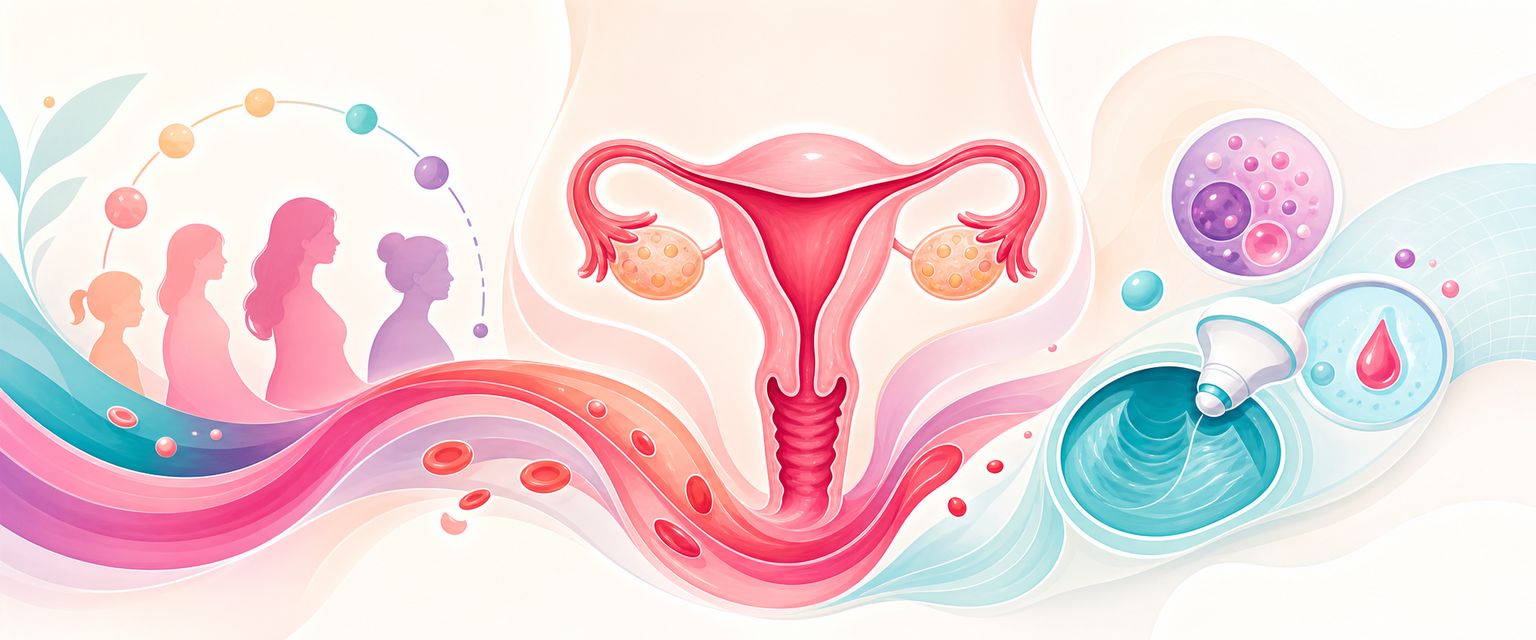
In one line
Heavy menstrual bleeding is excessive menstrual loss that impairs a woman's quality of life, classified by cause through FIGO PALM-COEIN; once pregnancy and malignancy are excluded and there is no structural lesion, the most effective medical treatment is the levonorgestrel intrauterine system, and the consultant's task is to match the intervention to the cause, the woman's fertility wishes, and — in South Africa — to what the service can actually deliver before her anaemia and her time run out.
Mechanism & pathophysiology
Menstruation is the controlled shedding of the secretory endometrium when the corpus luteum fails and progesterone withdrawal triggers it. The volume lost is set by a balance the endometrium itself controls: vasoconstriction of the spiral arterioles, platelet plug formation, and a brisk local fibrinolytic response that liquefies clot so the cavity does not obliterate. Normal loss is roughly 30–40 mL per cycle; loss above ~80 mL is the volume historically defined as menorrhagia and the level above which iron-deficiency anaemia becomes likely. The modern definition is deliberately not a millilitre count — it is bleeding that interferes with physical, social, emotional or material quality of life — because women do not measure their loss and the clinical problem is the impact, not the assay.
Two mechanisms produce heavy loss, and they map onto the management. Disordered local haemostasis is the dominant pathway in heavy bleeding from an anatomically normal uterus: the endometrium of women with heavy menstrual bleeding shows relative deficiency of the vasoconstrictors (endothelin, prostaglandin F2α) and an excess of vasodilatory prostaglandins (PGE2) and of plasminogen activators, so the vessels constrict poorly and the clot dissolves too fast. This is precisely why the two non-hormonal first-line drugs work where they do: tranexamic acid is an antifibrinolytic that blocks plasminogen activation and stems the excess clot lysis, and the NSAID mefenamic acid inhibits cyclo-oxygenase and rebalances the prostaglandin ratio. The drugs are not symptomatic afterthoughts — each corrects a specific limb of the deranged endometrial physiology.
The second mechanism is structural or systemic disruption of that haemostatic environment: a submucosal fibroid or polyp increasing endometrial surface area and distorting vascular architecture; adenomyosis enlarging the uterus and disrupting junctional-zone contractility; a coagulopathy removing the systemic clotting reserve; or anovulation removing progesterone so the endometrium proliferates unopposed under oestrogen, becomes thick and fragile, and sheds erratically and heavily. Anovulatory bleeding dominates at the two ends of reproductive life — the adolescent with an immature hypothalamic–pituitary–ovarian axis and the perimenopausal woman with failing follicular recruitment — and unopposed oestrogen is also the thread linking persistent anovulation to endometrial hyperplasia and carcinoma, which is why the same anovulatory pattern that looks benign in a 16-year-old is a malignancy concern in a 52-year-old. The mechanistic groundwork on the menstrual cycle, ovulatory physiology and the pathological lesions is assumed here from the Intermediate heavy-menstrual-bleeding chapters; the level above is reasoning from that physiology to a structured cause and a defensible plan.
FIGO PALM-COEIN is the structured classification that organises all of this and is the language an examiner expects. It separates causes into structural (assessable by imaging or histology) and non-structural:
- PALM — Polyp; Adenomyosis; Leiomyoma (subclassified by location, the clinically critical split being submucosal versus other); Malignancy and hyperplasia.
- COEIN — Coagulopathy; Ovulatory dysfunction; Endometrial (a primary disorder of endometrial haemostasis or inflammation, a diagnosis of exclusion); Iatrogenic (anticoagulants, copper IUD, exogenous hormones, and the breakthrough bleeding of progestin-only methods); Not otherwise classified (arteriovenous malformation, isthmocele/niche after caesarean). A woman can carry more than one category at once — a fibroid uterus in a woman who is also anovulatory — so the classification is annotated, not forced into a single box, and the discipline it imposes is that you assign each category present rather than stopping at the first lesion you find.
Assessment
The first job is to confirm the bleeding really is heavy and is menstrual, and the second is to exclude the two things that change everything — pregnancy and malignancy — before reaching for the PALM-COEIN work-up.
- Quantify by impact, not by volume. Ask about flooding, clots, double sanitary protection, changing protection at night, restriction of work, school or social activity, and the symptoms of anaemia (fatigue, breathlessness, pica). The Pictorial Blood Assessment Chart can support the history but the clinical anchor is the effect on the woman's life.
- A bleeding and coagulopathy screen from the history is mandatory, not optional. Heavy bleeding since menarche, a family history of bleeding disorder, postpartum haemorrhage, bleeding with dental work or surgery, or easy bruising/epistaxis should trigger investigation for an inherited bleeding disorder. Von Willebrand disease is the one to remember: in women presenting with menorrhagia its prevalence is around 13%, far higher than in the general population, and it is routinely missed because the bleeding is attributed to a gynaecological cause. The corollary is that coagulopathy is disproportionately the answer in the adolescent with heavy bleeding from the first period — she earns a coagulation screen, von Willebrand factor antigen and activity, and factor VIII before she earns a hormonal label.
- Examination is directed at the structural categories: abdominal and bimanual examination for an enlarged, bulky or irregular uterus (fibroids, adenomyosis), and speculum examination of the cervix — a friable or visible cervical lesion is biopsied, not smeared, exactly as for any suspected genital-tract cancer. A normal examination does not exclude a submucosal lesion.
- Baseline bloods: full blood count in every woman (the prevalence and consequence of iron deficiency make this non-negotiable), with ferritin to confirm depleted stores even when haemoglobin is still in range, and a pregnancy test in anyone of reproductive age. Thyroid function and a coagulation screen are directed by the history, not reflexive.
- Transvaginal ultrasound is the first-line structural investigation — it sizes and locates fibroids, raises adenomyosis, measures endometrial thickness and identifies a focal mass. Its weakness is the submucosal lesion in a thickened endometrium, where it under-reads polyps and intracavitary fibroids; saline-infusion sonography (sonohysterography) or hysteroscopy resolves the cavity directly and is the investigation when ultrasound is equivocal, when there is persistent intermenstrual bleeding, or when a structural cause is suspected but not seen.
- Endometrial sampling is targeted, not universal. It is taken to exclude hyperplasia and carcinoma in the women whose pre-test probability justifies it: persistent intermenstrual or irregular bleeding, age and risk (the threshold falls steeply over the mid-40s, and any postmenopausal bleeding is sampled regardless), unopposed-oestrogen risk (obesity, PMOS — polycystic/metabolic ovarian syndrome, previously PCOS — tamoxifen, a strong family history), and failure of medical treatment. A blind office biopsy that misses a focal lesion is a false reassurance; where a focal abnormality is suspected, sampling is done under hysteroscopic vision so the lesion is actually hit. The principle that organises sampling thresholds is simple: you sample whenever the risk of an endometrial neoplasm is high enough that a normal scan is not enough to rest on.
Management
Structure the answer immediate → ongoing → long-term, and let the structural/non-structural split from PALM-COEIN drive the choice: where there is no structural cause, medical treatment leads; where there is, treatment is directed at the lesion; surgery — ablation or hysterectomy — is for failed medical treatment or specific structural disease, and the route and radicality are themselves consultant decisions.
Immediate — the acutely bleeding woman. Heavy acute uterine bleeding is resuscitation first: assess haemodynamic status, secure intravenous access, send a full blood count, group-and-save or cross-match, and a pregnancy test. High-dose oral or intravenous tranexamic acid is the workhorse haemostatic and is started while the cause is sorted out. High-dose progestogen (for example norethisterone 5 mg three times daily, weaned as the bleeding settles) or a course of combined oral contraception will arrest most dysfunctional acute bleeds medically; the principle is to stabilise the proliferative, fragile endometrium and convert it to a structured shed, not to stop bleeding by a single mechanism. Surgical control — examination under anaesthesia, hysteroscopic resection of a bleeding lesion, or a Foley-catheter or balloon tamponade as a temporising measure — is reserved for bleeding that does not settle or where a structural lesion is identified. Transfusion is for haemodynamic need, not for a haemoglobin number alone, but a profoundly anaemic woman who is still bleeding needs both blood and definitive haemostasis. The young woman who presents in extremis with heavy bleeding from menarche, having never been worked up, is the one in whom a previously undiagnosed bleeding disorder declares itself — resuscitate, control the bleeding, and screen for coagulopathy on the same admission rather than discharging her on the oral contraceptive pill with the question unanswered.
Ongoing — medical treatment where there is no structural cause. The hierarchy is evidence-led, not preference-led:
| Option | Mechanism / note | Place in therapy |
|---|---|---|
| LNG-IUS | Local progestogen; profoundly thins the endometrium | Most effective medical option; first-line unless declined or contraindicated. Also treats fibroids <3 cm not distorting the cavity, and adenomyosis |
| Tranexamic acid | Antifibrinolytic, taken only on bleeding days | Effective non-hormonal first-line if LNG-IUS declined; does not affect fertility, so suits a woman trying to conceive |
| NSAIDs (mefenamic acid) | Reduces prostaglandin-driven loss; also eases dysmenorrhoea | Non-hormonal option; weaker than tranexamic acid for volume but adds analgesia |
| Combined hormonal contraception | Cycle control + contraception | Where contraception is also wanted and no contraindication |
| Cyclical / long-course oral progestogens | Norethisterone days 5–26 (not luteal-only) | Long-course regimens reduce loss; short luteal-phase courses do not — a common error |
The single most important contraindication check before the LNG-IUS is that there is no untreated endometrial pathology or unexplained intermenstrual/postmenopausal bleeding — fitting a device into an unsampled high-risk uterus can mask a developing carcinoma. Iron-deficiency anaemia is treated in parallel with all of the above: oral iron is first-line and continued for ~3 months after the haemoglobin normalises to refill stores; intravenous iron is for intolerance, malabsorption or the need to correct quickly before surgery.
Ongoing — treatment directed at a structural cause.
- Polyp — hysteroscopic polypectomy; it is both diagnostic and curative and resolves the bleeding directly.
- Submucosal fibroid — hysteroscopic (transcervical) resection for an intracavitary fibroid is highly effective and uterus-sparing.
- Larger / intramural fibroids — the options are the LNG-IUS or other medical treatment for small fibroids not distorting the cavity, myomectomy (open, laparoscopic or hysteroscopic, fertility-sparing), uterine artery embolisation (uterus-conserving but with a higher later re-intervention rate and an uncertain effect on fertility, so generally avoided in a woman wanting to conceive), and hysterectomy for definitive cure where fertility is complete. GnRH analogues shrink fibroids and correct anaemia pre-operatively but are a bridge, not a destination, because the fibroids regrow.
- Adenomyosis — the LNG-IUS is the uterus-sparing mainstay; hysterectomy is the definitive treatment when the uterus is not to be kept. The diagnosis and deep-disease management overlap the endometriosis–adenomyosis chapter, where the imaging and surgical detail belong.
Long-term — surgery and the definitive decision. When medical treatment fails or is declined and the woman has completed her family, the choice is between endometrial ablation and hysterectomy:
- Endometrial ablation destroys the endometrium and is uterus-sparing, day-case, and quick to recover from. Second-generation devices (thermal balloon, bipolar radiofrequency) are as effective as the older hysteroscopic resection and are faster and more often done under local anaesthesia. It is suited to a normal or near-normal cavity, demands reliable contraception afterwards (a pregnancy on an ablated endometrium is dangerous), and a proportion of women will still come to hysterectomy later.
- Hysterectomy is the definitive cure — it guarantees amenorrhoea and the highest satisfaction — at the cost of major surgery and its complications. Route follows a clear preference order: vaginal where feasible, then laparoscopic, with abdominal hysterectomy reserved for the large or fixed uterus or where access demands it — the minimal-access routes carry less morbidity and faster recovery. Conserving the ovaries in a premenopausal woman is the default unless there is a specific reason to remove them.
In the South African public service these are not equivalent choices on a menu. The LNG-IUS is the highest-value single intervention — it converts most heavy-bleeding women into a managed outpatient problem and spares scarce theatre lists, which is precisely why securing reliable LNG-IUS supply at clinic and district level changes outcomes more than any surgical technique. Its uneven availability is the real-world constraint to name: where the device is genuinely unobtainable, tranexamic acid plus a progestogen and aggressive iron repletion is the deliverable plan, and the woman is not left untreated while waiting for a device that may not arrive.
Iron-deficiency anaemia deserves its own line in the South African answer because it is not a footnote to the bleeding — it is the commonest and most consequential complication, and in many women it is the reason they present at all. Heavy menstrual loss is the leading cause of iron deficiency in reproductive-age women, and in a setting where dietary iron intake is often marginal and the baseline anaemia burden high, the heavy-bleeding woman frequently arrives already iron-depleted, sometimes profoundly so. The plan therefore runs on two tracks in parallel: control the bleeding and correct the iron, because controlling the bleeding alone leaves a tired, breathless, under-functioning woman whose stores will take months to refill on their own. Oral ferrous sulphate or fumarate is first-line, cheap and on the Essential Medicines List, and is continued for around three months beyond haemoglobin normalisation to rebuild ferritin; intravenous iron is reserved for genuine oral intolerance, malabsorption, or the need to correct quickly before surgery. The woman whose bleeding is controlled but whose anaemia is ignored has been half-treated.
Guidelines compared
The major bodies broadly agree on the structure; the value of comparing them is seeing where the emphasis and the certainty differ.
| Body | Classification | First-line medical | Notable position |
|---|---|---|---|
| FIGO | Owns PALM-COEIN; the reference framework worldwide | — | Classification, not a treatment algorithm; everyone else maps onto it |
| NICE (NG88) | PALM-COEIN aligned | LNG-IUS first (no pathology; fibroids <3 cm not distorting cavity; adenomyosis) | "Do not offer blind endometrial biopsy"; ulipristal acetate recommendations restricted after the liver-injury safety signal |
| RCOG / ACOG | PALM-COEIN aligned | LNG-IUS / medical options, consistent with NICE | Detailed structural-cause pathways (fibroids, coagulopathy in adolescents); ACOG emphasises the adolescent coagulopathy work-up |
| SA NDoH / EML | PALM-COEIN in practice | Medical first, LNG-IUS where available; tranexamic acid + progestogen otherwise | Frames choice around EML drug availability, iron-deficiency anaemia, and district→regional→tertiary referral for surgery |
The recent change worth flagging is ulipristal acetate. It was a licensed oral option that shrank fibroids and controlled bleeding, but reports of serious liver injury led to a major restriction of its use; NICE amended its NG88 recommendations accordingly. Quoting ulipristal as a routine first-line oral fibroid drug now is out of date — its place is narrow and conditional. The other genuine divergence is one of investigation philosophy rather than treatment: NICE's explicit instruction against blind endometrial biopsy in favour of hysteroscopically-directed sampling reflects a real shift away from the older reflexive office-pipelle-for-everyone approach.
The evidence & the controversy
The single most important evidence point — and the one that re-ordered first-line treatment — is that the LNG-IUS outperforms the other medical options. The pragmatic primary-care trial ECLIPSE randomised 571 women with heavy menstrual bleeding to the LNG-IUS or to "usual" medical treatment (tranexamic acid, mefenamic acid, combined oestrogen–progestogen or progestogen) and measured the patient-reported impact on quality of life. Both arms improved, but the improvement was significantly greater and more durable with the LNG-IUS over two years, and far more women were still using the LNG-IUS at two years than were continuing their tablets — adherence is itself part of the effect, because a device cannot be forgotten the way a tablet can. The honest nuance, and the part candidates miss, is the five-year follow-up: by five years the between-group difference in quality of life was no longer statistically significant, both groups had improved markedly from baseline, and surgery rates were low in both. The defensible reading is that LNG-IUS is the most effective initial choice and the one most women stick with, but that committed medical treatment of any kind, sustained, gets most women to a good place without surgery — which is a more useful message than "the coil is always best".
The second controversy is the surgical endpoint: ablate or remove? Ablation is less invasive with faster recovery, but it trades that against a real later-hysterectomy rate; hysterectomy is definitive and gives the highest satisfaction but is major surgery with more complications. The Cochrane evidence frames this as a genuine trade-off rather than a winner: ablation versus hysterectomy shows hysterectomy more effective for bleeding and satisfaction but with more peri-operative morbidity and a far higher need for blood transfusion, while ablation's lower up-front cost narrows over time as a proportion of women return for retreatment or hysterectomy. Within ablation, second- and first-generation devices are equally effective, so the modern second-generation devices win on speed and anaesthetic burden, not on cure rate. For a resource-limited service the implication is concrete: a quick second-generation ablation under local anaesthesia spares a theatre slot and an inpatient bed, but the woman must be counselled that it is not always permanent.
The third live question is fibroid-directed therapy, and specifically uterine artery embolisation versus surgery. The FEMME trial randomised women with symptomatic fibroids who wanted to avoid hysterectomy to myomectomy or to uterine artery embolisation and found myomectomy gave a better fibroid-related quality of life at two years. Cochrane data add that embolisation offers shorter hospital stay, faster recovery and less transfusion than surgery, with similar major-complication and short-term satisfaction rates, but a higher rate of later re-intervention. The reconciliation is by patient: embolisation is a legitimate uterus-conserving choice in a woman who has completed her family and wants to avoid surgery, while a woman who wants the best symptom and fertility outcome and will accept an operation is better served by myomectomy — and the fertility data after embolisation remain weak enough that it is generally avoided where pregnancy is desired.
The objective is explicit about the lifespan, and the cause shifts predictably with age in a way that should reshape the work-up rather than just the dose. In the adolescent, anovulation from an immature hypothalamic–pituitary–ovarian axis is the usual cause, but it is also the age at which an inherited bleeding disorder most often surfaces, so heavy bleeding from menarche is a coagulopathy work-up first and a hormonal problem second; structural disease is rare and aggressive investigation of the cavity is rarely warranted. In the reproductive years, structural causes — fibroids, polyps, adenomyosis — climb in frequency, and fertility wishes dominate the choice between uterus-sparing and definitive treatment. In the perimenopausal woman, the same anovulatory pattern that was benign in the teenager is now a malignancy question: unopposed oestrogen over years drives hyperplasia, the threshold to sample the endometrium falls steeply, and any postmenopausal bleeding is sampled regardless of the scan. The single classification, PALM-COEIN, applies throughout, but the pre-test probability of each category — and therefore the investigation you reach for — is set by where the woman is in her reproductive life.
A topical thread worth holding lightly: there is recurrent lay and social-media anxiety about endocrine-disrupting chemicals and additives in menstrual and sanitary products as a driver of menstrual dysfunction. The biological plausibility of endocrine disruptors is real and the area is under active study, but there is at present no robust evidence linking sanitary-product chemistry to heavy menstrual bleeding, and the danger in clinic is letting an unproven environmental attribution displace the PALM-COEIN work-up — a coagulopathy or an endometrial neoplasm does not announce itself, and it must not be missed because attention drifted to a contested exposure.
Landmark trials & key evidence
| Trial / review (year) | Question | Key finding | What it changed |
|---|---|---|---|
| ECLIPSE — Gupta (2013) | LNG-IUS vs usual medical treatment for HMB in primary care (n=571) | Greater, more durable QoL improvement with LNG-IUS over 2 yr (between-group MMAS difference 13.4 points, 95% CI 9.9–16.9); 64% vs 38% still on allocated treatment at 2 yr | Established the LNG-IUS as the most effective first-line medical treatment for HMB |
| ECLIPSE 5-year — Kai (2016) | Does the LNG-IUS advantage persist to 5 years? | At 5 yr the QoL difference was no longer significant (3.9 points, 95% CI −0.6 to 8.3); both arms improved hugely; surgery-free survival 80% vs 77% (HR 0.90) | Tempered the message — sustained medical treatment of any kind avoids surgery for most women |
| Antifibrinolytics — Bryant-Smith, Cochrane (2018) | Effectiveness/safety of tranexamic acid for HMB | TXA cut measured loss by ~53 mL/cycle vs placebo; better than progestogens and NSAIDs; less effective than the LNG-IUS; no clear excess of thromboembolism | Confirmed TXA as effective non-hormonal first-line; positioned it below the LNG-IUS |
| Ablation techniques — Bofill Rodriguez, Cochrane (2019) | Second- vs first-generation endometrial ablation | Equivalent efficacy (amenorrhoea, satisfaction); second-generation faster and more often under local anaesthesia | Made second-generation devices the practical default for ablation |
| Ablation vs hysterectomy — Fergusson, Cochrane (2019) | Endometrial ablation vs hysterectomy for HMB | Hysterectomy more effective for bleeding/satisfaction but more complications; ablation needs far more re-operation (RR ~16 at 1 yr); cost gap narrows over time | Framed ablation vs hysterectomy as a counselled trade-off, not a default |
| LNG-IUS vs thermal balloon ablation — Silva-Filho (2012) | 5-year outcomes, LNG-IUS vs thermal balloon ablation | Hysterectomy for failure 3.7% (LNG-IUS) vs 24% (ablation) at 5 yr; higher Hb and satisfaction with LNG-IUS | Reinforced the LNG-IUS as a durable alternative to ablation |
| LNG-IUS vs hysterectomy — Hurskainen (2004) | LNG-IUS vs hysterectomy for menorrhagia, 5-year RCT (n=236) | By 5 yr 42% of the LNG-IUS arm had still come to hysterectomy, yet satisfaction was equal (94% vs 93%) and QoL/anxiety/depression improved alike; cost per woman far lower with LNG-IUS ($2817 vs $4660) | Made the LNG-IUS a defensible first move before hysterectomy — same satisfaction at lower cost, with surgery held in reserve |
| FEMME — Manyonda (2020) | Myomectomy vs uterine artery embolisation for symptomatic fibroids (n=254) | Myomectomy gave better fibroid-related QoL at 2 yr (UFS-QOL 84.6 vs 80.0; adjusted difference 8.0 points, 95% CI 1.8–14.1) | Positioned myomectomy ahead of embolisation for symptom/QoL outcome in uterus-preserving fibroid treatment |
| UAE vs surgery — Gupta, Cochrane (2014) | Uterine artery embolisation vs surgery for fibroids | Shorter stay, faster recovery, less transfusion; similar major-complication/2-yr satisfaction; higher re-intervention (15–32% vs ~7% at 2 yr) | Defined embolisation as a valid uterus-conserving option with a re-intervention trade-off |
| FIGO PALM-COEIN 2018 — Munro (2018) | Classify the causes of abnormal uterine bleeding | Updated the structural (PALM) / non-structural (COEIN) classification and the bleeding-symptom nomenclature | The reference framework for diagnosis and reporting of HMB |
| PALM-COEIN original — Munro (2011) | Establish a common classification | Introduced PALM-COEIN | Replaced the inconsistent "DUB"/"menorrhagia" terminology |
| vWD in menorrhagia — Shankar (2004) | Prevalence of von Willebrand disease in menorrhagia | Overall 13% (95% CI 11–15.6%) across 988 women | Made coagulopathy screening a defensible routine in selected women, especially adolescents |
A worked figure for the LNG-IUS-versus-ablation comparison: in the five-year randomised data, the failure-driven hysterectomy rate was 3.7% with the LNG-IUS and 24% with thermal balloon ablation. The absolute difference is ~20 percentage points, so the number of women you would need to treat with the LNG-IUS rather than ablation to prevent one hysterectomy at five years is approximately 1 / 0.20 ≈ 5 — a small trial, so the precision is limited, but it is the kind of arithmetic that frames why a reversible outpatient device is a defensible first move before committing a woman to an ablation that may still end in surgery.
Exam traps & red flags
- Not excluding pregnancy and malignancy first. Heavy bleeding gets a pregnancy test in every reproductive-age woman and endometrial sampling whenever the neoplasm risk justifies it — postmenopausal bleeding, persistent intermenstrual bleeding, age and unopposed-oestrogen risk, or treatment failure. Fitting an LNG-IUS into an unsampled high-risk uterus can mask a carcinoma.
- Smearing a visible cervical lesion. A friable cervical mass is biopsied; cytology is a screening tool and a normal smear never excludes a visible cancer.
- Missing the coagulopathy, especially in the adolescent. Heavy bleeding since menarche, a bleeding family history, or surgical/dental bleeding earns a coagulation and von Willebrand screen — vWD is present in roughly one in eight women with menorrhagia and is routinely overlooked.
- Luteal-phase-only progestogen for HMB. Short luteal-phase courses do not reduce menstrual loss; long-course regimens (e.g. days 5–26) do. Prescribing the short course and calling treatment failed is an error of regimen, not of drug.
- Quoting ulipristal acetate as routine first-line. Its use is restricted after the serious liver-injury signal; it is not a routine oral fibroid drug.
- Offering embolisation to a woman wanting fertility. Uterine artery embolisation conserves the uterus but the fertility data are weak and it carries a higher re-intervention rate; FEMME favoured myomectomy for symptom outcome, and a woman seeking pregnancy is generally steered to myomectomy.
- Defaulting to abdominal hysterectomy. Vaginal-then-laparoscopic is the route preference; an abdominal hysterectomy for a normal-sized mobile uterus imposes avoidable morbidity.
- Treating the haemoglobin and ignoring the stores. A normal haemoglobin with low ferritin is still iron deficiency; iron is continued for months after the count recovers, and an anaemic woman due for surgery is corrected first.
- Forgetting contraception after ablation. Pregnancy on an ablated endometrium is dangerous; reliable contraception is part of the ablation plan.
- Letting an unproven environmental attribution displace the work-up. The structured PALM-COEIN evaluation is not optional because a contested exposure offers an easier story.
Evidence anchors
- ECLIPSE — Gupta et al., LNG-IUS vs medical therapy for menorrhagia, N Engl J Med 2013
- ECLIPSE 5-year — Kai et al., Br J Gen Pract 2016
- Antifibrinolytics for heavy menstrual bleeding — Bryant-Smith et al., Cochrane 2018
- Endometrial resection and ablation techniques — Bofill Rodriguez et al., Cochrane 2019
- Endometrial ablation vs hysterectomy — Fergusson et al., Cochrane 2019
- LNG-IUS vs thermal balloon ablation, 5-year follow-up — Silva-Filho et al., Contraception 2012
- LNG-IUS vs hysterectomy for menorrhagia, 5-year RCT — Hurskainen et al., JAMA 2004 (equal satisfaction, lower cost; 42% later came to hysterectomy)
- FEMME — Manyonda et al., uterine-artery embolisation or myomectomy for fibroids, N Engl J Med 2020
- Uterine artery embolisation for symptomatic fibroids — Gupta et al., Cochrane 2014
- FIGO PALM-COEIN, 2018 revisions — Munro et al., Int J Gynaecol Obstet 2018
- FIGO PALM-COEIN, original classification — Munro et al., Fertil Steril 2011
- von Willebrand disease in women with menorrhagia — Shankar et al., BJOG 2004
- NICE NG88 — Heavy menstrual bleeding: assessment and management (2018, updated 2021)
- South African National Department of Health Standard Treatment Guidelines and Essential Medicines List (Hospital Level, Adults) — medical treatment of heavy menstrual bleeding and management of iron-deficiency anaemia; LNG-IUS availability and the district→regional→tertiary referral pathway for surgical management.
