In one line
Endometriosis is a chronic, oestrogen-dependent, progesterone-resistant inflammatory disease in which endometrium-like tissue outside the uterus drives pelvic pain and subfertility; adenomyosis is its intramyometrial cousin. The consultant task is to treat the symptom the woman actually has — pain or fertility, rarely both at once with the same intervention — and to recognise that the modern diagnosis is clinical and imaging-based, that medical suppression is first-line and empirical, and that surgery for an endometrioma always costs ovarian reserve.
The disease-mechanism groundwork is covered at endometriosis pathophysiology; the focus here is the consultant decision — defending a management plan from the evidence and the South African resource reality.
Mechanism & pathophysiology
No single theory accounts for endometriosis, and a candidate who offers only retrograde menstruation has misread the disease. The mechanism is a convergence of an anatomical seeding event, a permissive host, and an autonomous lesion biology.
- Sampson's retrograde menstruation remains the dominant explanation for pelvic disease: viable endometrial fragments reflux through the tubes and implant on peritoneum, ovary and pouch of Douglas. It is anatomically persuasive — the gravity-dependent and left-sided predilection (the sigmoid shelters the left adnexa) fits — but it cannot be the whole story, because retrograde menstruation occurs in up to 90% of menstruating women while only ~10% develop endometriosis. The reflux is necessary, not sufficient.
- Coelomic metaplasia (Meyer) explains disease where reflux cannot reach — the pleura, and the rare cases in women without a functioning uterus — by proposing that peritoneal mesothelium, sharing a coelomic-epithelial origin with the Müllerian tract, transforms into endometrium-like tissue under hormonal or inflammatory stimulus.
- Stem/progenitor-cell and lymphovascular dissemination account for distant deposits (umbilical, thoracic, even cerebral), positing that bone-marrow-derived or endometrial progenitor cells circulate and engraft.
- The immune and inflammatory defect is what converts seeding into established disease. Peritoneal macrophages in affected women clear refluxed tissue poorly and instead secrete a pro-inflammatory, pro-angiogenic milieu (IL-1, IL-6, IL-8, TNF-α, VEGF) that lets implants survive, vascularise and incite the nociceptor sprouting and neuroangiogenesis underlying the pain.
Two molecular features unify the picture and dictate treatment. First, the lesions are oestrogen-dependent and locally oestrogen-generating: ectopic stroma over-expresses aromatase (absent in normal endometrium) and is deficient in 17β-hydroxysteroid dehydrogenase type 2, so it both synthesises oestradiol locally and fails to inactivate it — a self-amplifying loop, with COX-2-driven prostaglandin E2 further upregulating aromatase. This is why every effective hormonal therapy works by lowering or opposing oestrogen, and why aromatase inhibitors have a niche in refractory disease. Second, the lesions are progesterone-resistant: progesterone-receptor (chiefly PR-B) expression is blunted, so the normal progesterone brake on endometrial proliferation fails. Progesterone resistance is the reason a progestogen suppresses some women beautifully and barely touches others, and the conceptual basis for the whole disease behaving like an unopposed-oestrogen state in miniature.
The pain itself has its own pathophysiology, and understanding it explains why excising lesions does not always abolish symptoms. Early pain is nociceptive and cyclical, driven by prostaglandins and inflammatory mediators; with time the lesions recruit their own nerve supply (neuroangiogenesis), and persistent peripheral input sensitises the dorsal horn and central pain pathways. Once central sensitisation is established, pain becomes constant, spreads beyond the pelvis, and persists despite complete lesion clearance — which is why a fixated surgical answer ("find and cut all of it") fails the woman whose pain has become a chronic-pain syndrome, and why pain-medicine input, not more surgery, is sometimes the right escalation.
The disease is not one phenotype but three, with different biology and surgery:
- Superficial peritoneal endometriosis — implants on peritoneal surfaces; the commonest form, the one whose pain correlates worst with what the eye sees at laparoscopy.
- Ovarian endometrioma ("chocolate cyst") — a pseudocyst lined by endometriotic tissue and filled with altered (haemosiderin-laden) blood. Its wall is inseparable from ovarian cortex, which is why excising it removes follicles.
- Deep infiltrating endometriosis (DIE) — nodular disease penetrating >5 mm beneath the peritoneum into the uterosacral ligaments, rectovaginal septum, bowel, bladder or ureter. It behaves more like a fibrotic, adenomyosis-like lesion than a surface implant, distorts anatomy, and is the disease that obstructs ureters and infiltrates rectum — the one that demands a multidisciplinary surgical team.
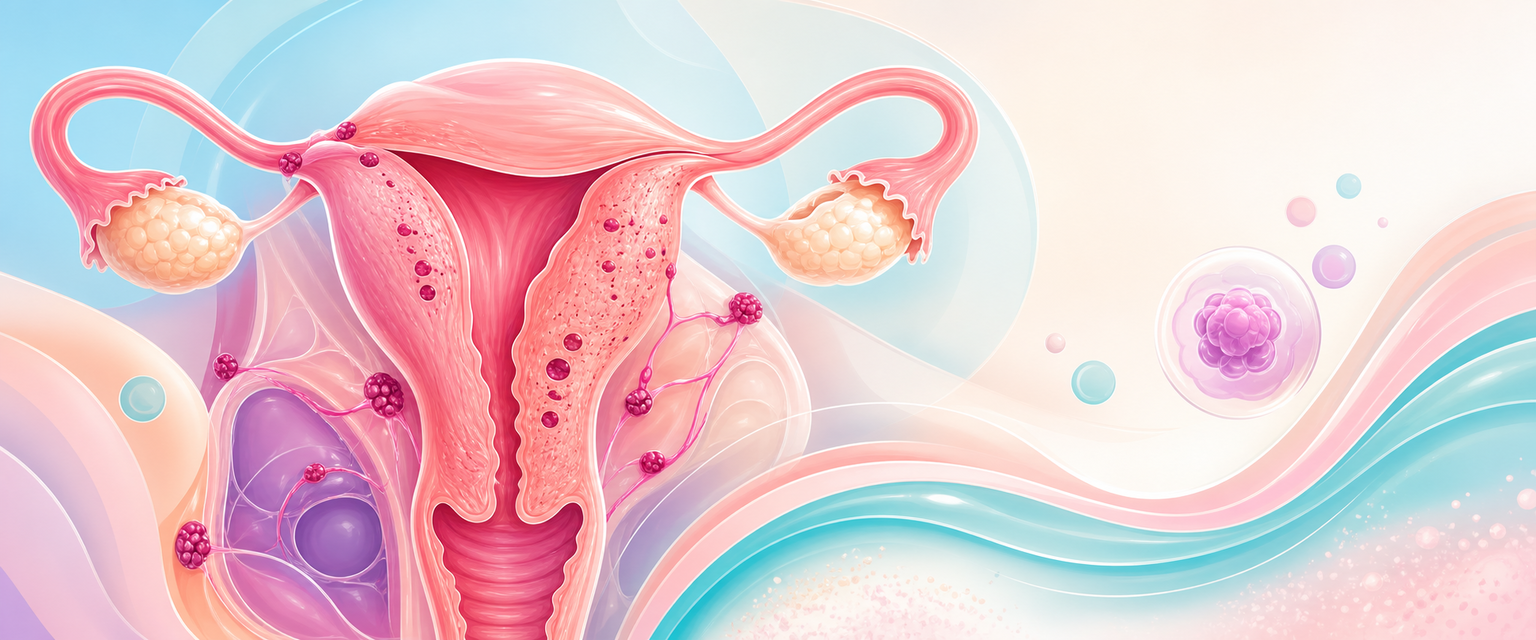
Adenomyosis is endometrium-like glands and stroma within the myometrium, surrounded by reactive smooth-muscle hyperplasia. The favoured mechanism is invagination of the basal endometrium across a disrupted endometrial–myometrial junctional zone, with the same oestrogen-dependence and progesterone resistance as endometriosis, plus dysfunctional uterine peristalsis. Mechanical and inflammatory disruption of the junctional zone — by tissue-injury-and-repair at the basalis, and plausibly by prior uterine instrumentation or pregnancy — is thought to initiate the invagination, after which the ectopic foci provoke the surrounding myometrial hyperplasia that makes the uterus bulky and the junctional zone thick on imaging. The result is a globular, tender, often symmetrically enlarged uterus producing heavy menstrual bleeding and progressive dysmenorrhoea, and increasingly recognised as a contributor to subfertility and adverse obstetric outcomes through impaired junctional-zone peristalsis and implantation. The two diseases overlap heavily — a large share of women with endometriosis have coexistent adenomyosis on imaging — and that coexistence partly explains why some women fail conservative endometriosis surgery: the uterus itself is a pain generator that pelvic excision never addressed.
Assessment
Diagnosis has shifted decisively in the last decade: laparoscopy is no longer the mandatory gold standard, and a confident clinical-plus-imaging diagnosis now starts treatment without an operation. The reasoning is twofold — laparoscopy carries surgical risk and a negative laparoscopy does not exclude disease (microscopic and non-pigmented lesions are missed), and delaying empirical treatment until a diagnostic operation prolongs the already notorious diagnostic delay (typically years from symptom onset). Both ESHRE 2022 and NICE NG73 now support diagnosis on a characteristic symptom pattern and imaging, reserving surgery for treatment or for diagnostic uncertainty.
The symptom pattern is the diagnosis until proven otherwise:
- Cyclical, then chronic, pelvic pain — initially perimenstrual, progressing to constant pain as central sensitisation sets in. Pain that has lost its cyclicity signals a chronic-pain syndrome, not necessarily worse lesions.
- Secondary dysmenorrhoea that is progressive and increasingly refractory to simple analgesia.
- Deep dyspareunia — particularly with uterosacral or rectovaginal DIE.
- Cyclical bowel or bladder symptoms (dyschezia, haematochezia, dysuria, cyclical haematuria) — pointers to deep disease infiltrating rectum, bladder or ureter.
- Subfertility — by adhesions and distorted anatomy, impaired oocyte quality and a hostile inflammatory peritoneal environment.
Examination is often unremarkable in superficial disease, but the signs of deep disease are specific and worth eliciting deliberately: a fixed, retroverted uterus, tender nodularity or thickening of the uterosacral ligaments and rectovaginal septum on bimanual and rectovaginal examination, an adnexal mass (endometrioma), and visible blue/red lesions in the posterior fornix. A bulky, tender, globular uterus suggests adenomyosis.
Investigations — what each adds and where it fails:
- Transvaginal ultrasound (TVS) is first-line imaging and, in expert hands, is now a powerful diagnostic tool, not just an endometrioma-finder. It reliably detects the ground-glass echogenicity of an endometrioma, and a structured operator can identify DIE markers — a fixed retroverted uterus, loss of the sliding sign in the pouch of Douglas (obliteration), uterosacral and rectovaginal nodules, and bladder lesions. Its great limitation is operator-dependence and a near-blindness to superficial peritoneal disease: a normal TVS never excludes endometriosis.
- MRI is the problem-solving modality for mapping deep disease before surgery — rectovaginal and bowel involvement, ureteric proximity, and adenomyosis (a thickened junctional zone >12 mm, myometrial cysts). It does not replace TVS as the first test; it answers the surgical-planning question.
- CA-125 is for confusion, not diagnosis. It is often mildly raised in endometriosis but is neither sensitive nor specific (it rises in many benign and malignant conditions and may be normal in significant disease), so it must not be used to screen, diagnose or monitor. Its only honest role is in the work-up of a complex adnexal mass where malignancy must be excluded.
- Ureteric assessment (renal tract ultrasound for hydronephrosis) is mandatory where deep posterolateral disease is suspected — silent ureteric obstruction can destroy a kidney.
Staging exists, but it does not stage what the woman feels. The revised ASRM (rASRM) system grades I–IV on a points score for lesion type, depth, size and adhesions, and the #Enzian classification describes the deep and retroperitoneal compartments — uterosacral/rectovaginal, vaginal, bowel, ureter, bladder — that TVS and MRI now define, complementing rASRM where it is weakest. Both are useful for documentation and surgical communication, but the cardinal consultant point is that stage correlates poorly with pain and weakly with fertility. A woman with stage I disease may be in agony; a woman with a large stage IV endometrioma may be asymptomatic. For fertility prognosis specifically, the Endometriosis Fertility Index (EFI) — built from an intraoperative least-function score (the summed function of tube, fimbria and ovary on the better and worse sides) plus historical factors (age, years of infertility, prior pregnancy) — predicts non-IVF pregnancy far better than rASRM stage, which is why it is the tool to reach for after surgical staging in a woman trying to conceive: a high EFI justifies a defined window of expectant or non-IVF management, a low EFI argues for moving promptly to IVF rather than wasting fertile time.
Management
The first decision is not what drug or operation but what are we treating — pain or fertility — because the two goals pull in opposite directions: hormonal suppression that controls pain also suppresses ovulation and so cannot be used by a woman trying to conceive, and surgery undertaken for fertility (endometrioma cystectomy) costs the very ovarian reserve she needs. Structure the plan immediate → ongoing → long-term, and keep the pain pathway and the fertility pathway separate.
Pain — immediate and first-line
- Analgesia. NSAIDs are first-line for dysmenorrhoea (rational, given prostaglandin-driven pain), with paracetamol; neither modifies the disease, and reliance on escalating analgesia alone is undertreatment.
- First-line hormonal suppression — empirical, no laparoscopy required. A combined hormonal contraceptive (continuous or extended-cycle to abolish menstruation) or an oral/depot progestogen is offered first. The therapeutic logic is to create a stable, low-oestrogen, progestogen-dominant, amenorrhoeic state — turning off the cyclical stimulus the lesions feed on. ESHRE and NICE both endorse starting this on clinical suspicion. Dienogest (a selective progestogen) is a well-evidenced choice specifically licensed for endometriosis pain.
- The LNG-IUS delivers progestogen locally, controls dysmenorrhoea and bleeding with minimal systemic exposure, and is the single highest-value device in this disease — it doubles as treatment for the heavy menstrual bleeding of coexistent adenomyosis. It is the pragmatic SA workhorse where it is accessible.
Pain — second-line, when first-line fails
- GnRH agonists (leuprolide, goserelin) induce a profound hypo-oestrogenic, pseudo-menopausal state and are highly effective, but the resulting bone-mineral-density loss and vasomotor symptoms make them unusable long-term without add-back therapy (low-dose oestrogen + progestogen, or tibolone), which protects bone and quality of life without losing pain control. They are second-line precisely because of this oestrogen-deprivation cost and the need for add-back.
- GnRH antagonists are the modern advance: oral, rapid-onset, dose-titratable suppression without the initial flare of agonists. Elagolix and relugolix combination therapy (relugolix with built-in oestradiol/progestin add-back) deliver effective pain control while the add-back limits bone loss — the design intent is durable, oral, outpatient suppression that replaces both repeat surgery and opioids. In SA these are largely tertiary/private-sector agents at present.
- Aromatase inhibitors (letrozole), combined with a progestogen or COC to prevent ovarian stimulation, are a niche option for disease refractory to standard suppression, exploiting the local-aromatase biology directly.
Pain — surgery
Surgery for pain is offered when medical therapy fails, is not tolerated, or where there is an endometrioma or deep disease to address. The principle is excise or ablate all visible disease at laparoscopy.
- For superficial peritoneal disease, excision and ablation both reduce pain; the evidence does not clearly favour one technique.
- For an ovarian endometrioma, cystectomy (excision of the cyst wall) beats drainage/ablation for recurrence and pain — but at a documented cost to ovarian reserve, because cortex containing follicles is inevitably removed with the wall. This trade-off governs the whole decision (developed below).
- Deep infiltrating endometriosis is specialist MDT surgery: bowel, bladder and ureteric involvement demand colorectal and urological input, pre-operative mapping (MRI), and full counselling about the risk of bowel resection, stoma, fistula and ureteric injury. It must not be attempted opportunistically by a general gynaecologist who finds it unexpectedly — recognise it, stop, and refer.
- Definitive surgery — hysterectomy ± bilateral salpingo-oophorectomy with excision of all disease — is reserved for women who have completed their family and failed conservative measures. Removing the uterus alone does not cure endometriosis if disease is left behind; oophorectomy removes the oestrogen source but commits a young woman to surgical menopause, for which oestrogen-based HRT is then appropriate.
Fertility-focused management — a separate algorithm
Here hormonal suppression is counterproductive (it prevents conception and has no proven role in improving spontaneous fertility), so the levers are surgery and assisted reproduction, chosen by age, ovarian reserve, disease stage and the partner's semen.
- Surgery to improve fertility. Laparoscopic ablation/excision of endometriosis probably improves the spontaneous pregnancy rate versus diagnostic laparoscopy alone — the Cochrane evidence supports an improved viable intrauterine pregnancy rate. The EFI then guides expectant management versus moving to ART.
- Endometrioma and the ovarian-reserve trade-off. Cystectomy improves access for oocyte retrieval and treats pain, but measurably lowers anti-Müllerian hormone and antral follicle count — and bilateral endometrioma surgery can be catastrophic for reserve. In a woman whose priority is fertility, the calculus often favours proceeding straight to IVF rather than operating on an asymptomatic endometrioma, particularly with bilateral cysts or already-low reserve. Operate for pain or diagnostic doubt, not reflexively for the cyst's existence.
- Assisted reproduction. IVF is effective in endometriosis-associated subfertility and is the route when tubal function is compromised, reserve is falling, there is male factor, or surgery has failed. Endometriosis does not contraindicate IVF.
Adenomyosis-specific management
Adenomyosis is managed by its dominant symptom — heavy menstrual bleeding and dysmenorrhoea — and by fertility intent:
- LNG-IUS is first-line: it controls both bleeding and pain with strong evidence and uterus preservation.
- Combined hormonal contraceptives, oral progestogens, GnRH agonists/antagonists suppress symptoms similarly to endometriosis.
- Uterine artery embolisation (UAE) is a uterus-conserving option that reduces bulk symptoms and bleeding in women declining or unfit for surgery, though durability is less certain than for fibroids and its effect on future fertility is unresolved.
- Hysterectomy is the definitive cure for a woman who has completed her family — adenomyosis, being diffuse and intramyometrial, is the one of this pair that hysterectomy reliably cures.
Recurrence and the long view
Both diseases are chronic and recurrent: pain and lesions return in a substantial minority after conservative surgery, and the strongest evidence-based protection is long-term post-operative hormonal suppression (LNG-IUS or a progestogen/COC) to delay recurrence and reoperation. Frame this to the woman at the outset as a long-term medical condition managed over decades, not a single operation that fixes her — repeated, escalating surgery (especially repeat endometrioma cystectomy) progressively destroys ovarian reserve and rarely cures. The goal is durable medical control with surgery used sparingly and decisively.
The South African layer
The management ladder above has to be read against the structure of the SA service. At district level the realistic toolkit is clinical and TVS-based diagnosis plus empirical first-line suppression — NSAIDs, a continuous COC, an oral or depot progestogen, and the LNG-IUS where stock allows — which is exactly what the de-throning of laparoscopy makes legitimate and is the single most important practical consequence of the guideline shift for an SA clinician: a woman need not wait years for a tertiary laparoscopy slot to begin effective treatment. Expert TVS/MRI mapping, GnRH agonists with add-back, and deep-disease MDT surgery are tertiary commodities, and access — not knowledge — is usually the rate-limiter; the GnRH antagonists (elagolix, relugolix combination) are largely confined to the private sector at present. Referral discipline therefore matters: refer the suspected deep or ureteric disease, the endometrioma in a fertility patient, and the woman failing first-line suppression — but treat the rest where she presents, and do not let a referral letter substitute for starting therapy. The same access gradient shapes fertility care, where publicly funded IVF is scarce, sharpening the stakes of any decision to spend ovarian reserve on endometrioma surgery in a woman who may never reach assisted reproduction.
For the woman in front of you, the plan therefore reads as a single sentence the candidate should be able to say aloud: confirm the pattern clinically and on TVS, decide whether the goal is pain or fertility, start empirical suppression for pain (LNG-IUS where possible) or move down the surgery/ART fertility arm, reserve GnRH agents and MDT surgery for failure or deep disease, and commit to long-term medical maintenance because the disease comes back.
Guidelines compared
The major bodies broadly agree on the framework but diverge on emphasis, and the live theme across all of them is the move away from mandatory laparoscopy.
| Issue | ESHRE 2022 | NICE NG73 (2017, upd. 2024) | SA NDoH / EML reality |
|---|---|---|---|
| Diagnosis | Clinical + imaging accepted; laparoscopy no longer the required gold standard; negative laparoscopy does not exclude | Diagnose on symptoms/signs + TVS/MRI; do not delay treatment for laparoscopy | TVS first-line; expert TVS/MRI and laparoscopy concentrated at tertiary centres |
| First-line pain therapy | Analgesia + COC or progestogen empirically | Same; emphasises offering treatment without diagnostic laparoscopy | COC, oral/depot progestogen, LNG-IUS per EML/SAMF |
| Second-line | GnRH agonist (with add-back) or antagonist | GnRH agonist with add-back if first-line fails | GnRH agonists tertiary; antagonists (elagolix/relugolix) largely private |
| Endometrioma surgery | Cystectomy better for recurrence/pain but counsel ovarian-reserve loss | Counsel ovarian-reserve risk; specialist referral | Cystectomy widely available; reserve-sparing technique variable |
| Deep disease | Refer to expert centre / MDT | Refer to specialist endometriosis centre | Tertiary MDT only; access and waiting are the rate-limiters |
| CA-125 | Not for diagnosis | Not recommended for diagnosis | Aligns |
The recent change worth flagging is the firm de-throning of laparoscopy as the diagnostic prerequisite, mirrored by both ESHRE's 2022 update and NICE's 2024 refresh — a genuine practice shift that lets a district-level clinician start treatment on clinical grounds, which matters enormously in a system where access to laparoscopy is the bottleneck. Where guidance is silent or weak is on the optimal management of the asymptomatic endometrioma in a fertility patient — here the evidence forces a case-by-case judgement, not a protocol.
The evidence & the controversy
The defining modern shift is from a surgical to a medical, clinical disease: diagnosed without an operation, treated empirically, with surgery reserved rather than reflexive. This reframes endometriosis as a chronic inflammatory condition managed over a lifetime, closer in spirit to a rheumatological disease than to a tumour to be cut out — and it directly serves a resource-limited system by uncoupling the start of treatment from the availability of theatre time.
The most consequential evidence story is the arrival of oral GnRH antagonists with built-in add-back. SPIRIT 1 and 2 and the Elaris programme establish that you can now achieve GnRH-agonist-grade suppression orally, titratably, and — crucially — with the add-back that limits the bone loss which always capped agonist use. The honest critique a viva expects: these are pain-and-quality-of-life drugs measured against placebo, not head-to-head against the cheap, available first-line agents that work well in most women; they have a real but modest BMD signal even with add-back; and in the SA public sector they are not yet affordable. The defensible position is that they are a major advance for the woman who has failed first-line suppression and faces repeat surgery or opioids — not a new first-line replacement for a continuous COC or an LNG-IUS that costs a fraction as much.
The sharpest live controversy is endometrioma surgery versus ovarian reserve. The old teaching — Hart's Cochrane review showing cystectomy beats drainage/ablation for recurrence, pain and spontaneous pregnancy — made excision the default. The correction is that cystectomy demonstrably lowers AMH and antral follicle count, and bilateral surgery can be devastating to reserve, so in a fertility patient the question is increasingly whether to operate at all rather than how. There is no clean trial that resolves this; the consultant answer holds both findings — excise when you operate, but think hard before operating on an asymptomatic cyst in a woman who needs her ovaries — and individualises by reserve, laterality, symptoms and the alternative of going straight to IVF.
A current thread worth weighing honestly is the public and social-media attention on environmental endocrine disruptors and phyto-oestrogens — including claims about chemicals in sanitary products — as drivers of oestrogen-dependent disease. The biological plausibility (an oestrogen-dependent disease, plausibly modifiable by xeno-oestrogenic exposure) is why the question deserves a straight answer rather than dismissal, but the human evidence linking specific consumer exposures to incident endometriosis is associational and inconsistent, and no guideline recommends an avoidance strategy on this basis. The right register is to acknowledge the legitimate question, label the evidence as contested and immature, and not let a patient defer effective treatment for an unproven environmental hypothesis.
Landmark trials & key evidence
| Trial / study (year) | Question | Key finding | What it changed |
|---|---|---|---|
| ESHRE guideline (Becker, 2022) | How should endometriosis be diagnosed and managed? | 109 recommendations; laparoscopy + histology no longer required as the diagnostic gold standard; first-line COC/progestogen, second-line GnRH agonist/antagonist | Cemented clinical/imaging diagnosis and empirical medical first-line; current reference guideline |
| Strowitzki (dienogest, 2010) | Dienogest 2 mg vs placebo for endometriosis pelvic pain | VAS pain fell 27.4 mm vs 15.1 mm (difference 12.3 mm, P<0.0001); well tolerated | Established a dedicated selective progestogen for endometriosis pain |
| Elaris EM-I/II (Taylor, 2017) | Oral GnRH antagonist elagolix vs placebo, 2 doses | Dysmenorrhoea responders up to 75.8% (200 mg bd) vs ~20% placebo; dose-dependent hypo-oestrogenic effects (BMD, lipids, hot flushes) | First oral GnRH antagonist proven for endometriosis pain |
| SPIRIT 1 & 2 (Giudice, 2022) | Relugolix combination therapy (with oestradiol/progestin add-back) vs placebo | Dysmenorrhoea responders ~75% vs ~27–30% placebo (difference ~45–48%, P<0.0001); add-back limited BMD loss to ~0.7–0.8% | Oral antagonist + add-back enabling durable suppression without agonist-grade bone loss |
| Hart Cochrane — endometrioma surgery (2008) | Excision (cystectomy) vs drainage/ablation of ovarian endometrioma | Lower recurrence of pain (OR 0.08–0.15) and endometrioma (OR 0.41), less reoperation (OR 0.21), more spontaneous pregnancy in prior subfertility (OR 5.21) | Made cystectomy the default — now tempered by the ovarian-reserve cost |
| Bafort Cochrane — laparoscopic surgery (2020) | Laparoscopic surgery vs diagnostic laparoscopy for pain and fertility | Effect on pain uncertain (low-quality); probably improves viable intrauterine pregnancy (OR 1.89, 95% CI 1.25–2.86) | Quantified the modest, fertility-weighted benefit of conservative surgery |
| Endometriosis Fertility Index (Adamson & Pasta, 2010) | A validated tool to predict non-IVF pregnancy after endometriosis surgery | EFI (least-function score + historical factors) predicts pregnancy rates; outperforms rASRM stage for fertility | Provided the fertility-prognosis instrument rASRM staging lacked |
A worked figure for the viva: in Strowitzki, dienogest reduced VAS pain by 27.4 mm against placebo's 15.1 mm — a placebo-subtracted treatment effect of 12.3 mm, which is why the trial is positive but also why a candidate should respect the large placebo response (15 mm) endometriosis pain trials consistently show, and not over-read open-label improvement as drug effect.
Exam traps & red flags
- Offering only retrograde menstruation as the mechanism. It is necessary but not sufficient — ~90% of women menstruate retrogradely and ~10% get the disease; the immune/inflammatory defect, local aromatase and progesterone resistance are what make it a disease.
- Treating a normal TVS or a normal CA-125 as excluding endometriosis. TVS misses superficial peritoneal disease; CA-125 is neither sensitive nor specific and has no diagnostic role — a normal result in a symptomatic woman changes nothing.
- Insisting on laparoscopy before treating. Both ESHRE 2022 and NICE NG73 endorse empirical first-line medical therapy on clinical grounds; demanding a diagnostic operation prolongs the diagnostic delay and wastes scarce theatre access.
- Staging the pain. rASRM stage correlates poorly with symptoms; quoting a stage to explain or predict pain is a conceptual error. Use the EFI, not the stage, to counsel fertility prognosis.
- Operating on an asymptomatic endometrioma in a fertility patient. Cystectomy lowers AMH and antral follicle count; bilateral surgery can be catastrophic for reserve. Often the right move is straight to IVF — operate for pain or diagnostic doubt, not for the cyst's mere presence.
- Tackling deep infiltrating disease opportunistically. DIE with bowel/bladder/ureteric involvement is MDT surgery with real risk of resection, stoma, fistula and ureteric injury — recognise it, do not attempt it ad hoc, and refer to a specialist centre.
- Missing silent ureteric obstruction. Deep posterolateral disease can obstruct a ureter without symptoms and destroy a kidney — image the renal tract when deep disease is suspected.
- Using hormonal suppression to treat subfertility. It prevents conception and has no proven fertility benefit; the fertility algorithm is surgery and ART, a separate pathway from the pain algorithm.
- Forgetting the uterus in adenomyosis-overlap pain. A woman who fails conservative endometriosis surgery may have coexistent adenomyosis driving her pain and bleeding; the LNG-IUS treats both, and definitive cure of adenomyosis is hysterectomy, not pelvic excision.
- Stopping suppression after surgery. Endometriosis recurs; long-term post-operative hormonal suppression (LNG-IUS or progestogen/COC) is the evidence-based way to delay recurrence and reoperation — discharging a post-operative patient on no maintenance invites the disease back.
Evidence anchors
- ESHRE guideline: endometriosis — Becker et al., Hum Reprod Open 2022
- NICE NG73 — Endometriosis: diagnosis and management (2017, updated Nov 2024)
- Dienogest in endometriosis-associated pelvic pain — Strowitzki et al., Eur J Obstet Gynecol Reprod Biol 2010
- Elagolix for endometriosis-associated pain (Elaris EM-I/II) — Taylor et al., N Engl J Med 2017
- Relugolix combination therapy (SPIRIT 1 & 2) — Giudice et al., Lancet 2022
- Excisional vs ablative surgery for ovarian endometriomata — Hart et al., Cochrane 2008
- Laparoscopic surgery for endometriosis — Bafort et al., Cochrane 2020
- Endometriosis Fertility Index — Adamson & Pasta, Fertil Steril 2010
- Revised ASRM (rASRM) staging and the #Enzian classification — surgical/imaging staging systems referenced in the ESHRE 2022 guideline; poor correlation with pain.
- South African EML / SAMF — availability of COCs, oral/depot progestogens, LNG-IUS and GnRH agonists by level of care; GnRH antagonists and deep-disease MDT surgery concentrated in tertiary/private practice.
