In one line
Induction of labour (IOL) is the iatrogenic initiation of labour before its spontaneous onset; the consultant skill is not knowing the agents but matching method to cervix, parity and uterine scar, quantifying the trade-off against expectant management, and recognising hyperstimulation early enough to rescue the fetus.
This chapter assumes the IOL groundwork in the FCOG Intermediate labour material — the basic indications, the Bishop components, how prostaglandins and oxytocin work, and the routine ripen-then-augment sequence. It works one level up: how the subtypes of induction differ mechanistically, how the named regimens diverge on dose and risk, how to read the trials onto the woman in front of you, and the judgement calls a new consultant owns. Cross-link down to VBAC and rupture groundwork and uterine-rupture for the scarred-uterus physiology.
Assessment
The pre-induction assessment decides everything downstream.
- Indication and its strength. Post-term, hypertensive disease, diabetes, fetal growth restriction, PPROM, cholestasis and reduced fetal movements all carry different urgency and different "by when" deadlines. Name the indication, the gestation and the consequence of not inducing — that triad sets the urgency of everything downstream.
- Confirm gestation and viability against a first-trimester scan; an "induction for post-dates" on uncertain dates is a recurrent error.
- Bishop score (dilatation, effacement, station, consistency, position). It is the single most important predictor of success. A score ≤6 defines an unfavourable cervix needing ripening; >6 means you can usually proceed straight to amniotomy and oxytocin. Bishop has modest predictive accuracy in nulliparas — interpret it alongside parity, not as a number in isolation.
- Uterine scar status and contraindications. A classical or prior-rupture scar, placenta praevia, vasa praevia, active genital herpes, transverse lie and most prior-uterine-surgery states are absolute contraindications. A single low-transverse scar is not a contraindication but changes the method (see Management).
- Fetal assessment — presentation (confirm cephalic), estimated weight, and a reassuring CTG before any agent. Assess macrosomia risk where relevant.
- Setting and capacity. In the SA district→regional→tertiary system, IOL with prostaglandin demands continuous-monitoring capacity and theatre access. An unfavourable VBAC or a growth-restricted fetus should be inducted where caesarean and neonatal support exist.
The advanced read — where the Bishop number misleads
The consultant does not treat the Bishop score as a verdict. Three nuances change management:
- It is a parity-conditioned probability, not a switch. A Bishop of 6 in a multipara who has delivered vaginally is a near-certain success; the same 6 in a nullipara at 41+5 with an unengaged head and a deflexed occipito-posterior position is a meaningfully different prospect, and the honest counselling is that her induction may well end in caesarean. The component that carries most weight is dilatation (and station/effacement); position and consistency are the soft, examiner-dependent components and the source of most inter-observer disagreement. When you and a colleague score the same cervix two points apart, it is almost always position and consistency that diverge.
- The modified Bishop and the "ripening threshold." Many SA units use the simplified Bishop (dilatation, effacement/length, station) because it reproduces better between observers than the full six-component score. The operationally important line is not 6 versus 7 but whether the cervix will accept an amniotomy at all: if you can sweep a finger to rupture membranes and there is room for a presenting part, you are establishing labour, not ripening it; if you cannot, you are ripening regardless of the integer.
- Transvaginal cervical length and "fetal fibronectin" add little once you have a finger in the cervix. Sonographic cervical length predicts induction success in research cohorts but does not outperform the digital Bishop enough to change a bedside decision; do not order it to decide an induction.
The judgement layer: state the indication's deadline explicitly (e.g. growth-restricted with a deteriorating ductus venosus — this fetus must be delivered within 24–48 h, so a slow multi-day ripening is the wrong tool, and the threshold to caesarean falls), because the urgency of the indication, not the Bishop score alone, sets how much induction time you can afford to spend.
Aetiology & subtypes — how the methods differ mechanistically
IOL is not one intervention but a family, and the contrast that matters is the mechanism of action of each, because mechanism predicts both the failure mode and the contraindication. The basic pharmacology is assumed:
1. Pharmacological cervical ripening — prostaglandins (the receptor-mediated subtype).
- PGE1 (misoprostol) acts on EP2/EP3 receptors to dissolve cervical collagen and drive myometrial contraction directly. Its defining property is that it is non-removable and non-titratable once absorbed — you cannot retrieve a swallowed or vaginally absorbed dose. This is the whole reason the route and formulation matter so much: oral solution gives a short ~2-hour half-life that you can titrate dose-by-dose, whereas a vaginal tablet or a sustained-release vaginal insert delivers a depot you cannot recall. The mechanistic consequence: misoprostol's direct uterotonic action is why it ruptures scarred uteri and why tachysystole is dose-driven, not idiosyncratic.
- PGE2 (dinoprostone) is the same receptor family but is formulated as a removable controlled-release pessary — the mechanistic advantage is purely retrievability, letting you stop the stimulus when tachysystole appears. It buys safety at the cost of cold-chain and expense.
2. Mechanical ripening — the balloon (the prostaglandin-independent subtype).
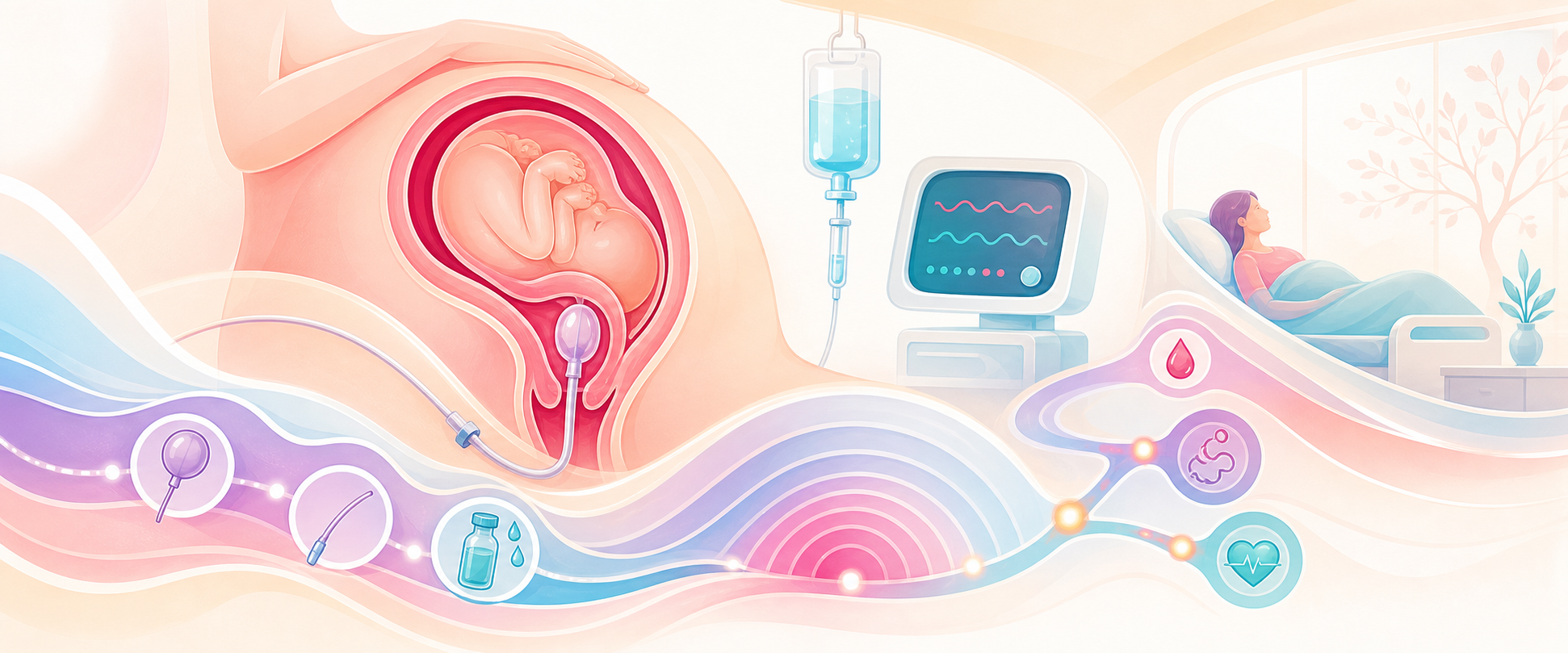
- A transcervical Foley or double-balloon ripens by direct stretch of the lower segment and cervix, which triggers endogenous prostaglandin and oxytocin release (a Ferguson-reflex-like local response) rather than delivering an exogenous uterotonic. The mechanistic consequence is decisive: because there is no exogenous uterotonic, the balloon essentially cannot cause pharmacological hyperstimulation, and the rupture risk in a scarred uterus approximates spontaneous labour. This is why it is the method of choice with a scar — not a guideline preference but a mechanistic one.
- The trade-off built into the mechanism: stretch ripens the cervix but does not establish contractions, so the balloon almost always needs sequential oxytocin afterward, and it is marginally slower to delivery than misoprostol.
3. Establishing/augmenting labour — oxytocin (the titratable subtype).
- IV oxytocin acts on myometrial oxytocin receptors whose density rises through gestation and labour; the clinical corollary is that the same infusion rate produces escalating effect as receptors upregulate, which is why oxytocin needs continuous titration and why a rate that was safe an hour ago can over-stimulate now. It has a short plasma half-life (~minutes), so stopping the infusion is itself the first tocolytic — a mechanism worth stating in the rescue sequence.
4. Membrane sweeping — the low-tech subtype.
- A finger sweep separates the chorion from the lower segment, releasing local prostaglandins and phospholipase A2. Mechanistically it promotes spontaneous labour rather than inducing it; it is an adjunct that defers formal IOL, not a method of it.
The unifying advanced point: the four subtypes sit on a spectrum from least controllable/most uterotonic (vaginal misoprostol depot) to most controllable/least uterotonic (balloon), and you choose where on that spectrum to sit by reading the scar, the fetal reserve and the resource setting. The scarred uterus and the compromised fetus push you toward the controllable end; affordability and storage push the SA system toward titrated oral misoprostol.
Management
Frame IOL as ripen → establish → augment → deliver, with continuous reassessment for the one complication that kills: hyperstimulation with fetal compromise.
Cervical ripening (Bishop ≤6). Three families of agents, contrasted:
| Method | Typical regimen | Strengths | Cautions |
|---|---|---|---|
| Oral misoprostol (PGE1) | SA practice: 200 µg tablet dissolved in 200 mL water → 20 µg (20 mL) orally 2-hourly, titrated to contractions | Cheap, heat-stable, no fridge, EML-listed, effective; titrated low-dose has the best overall utility profile | Hyperstimulation if dosed by ½/¼ tablets; never with a uterine scar |
| Vaginal dinoprostone (PGE2) | Tablet/gel or 10 mg controlled-release pessary | Removable pessary lets you stop the stimulus | Costly, cold-chain, limited at district level; same hyperstimulation risk |
| Mechanical (Foley/double balloon) | 30–60 mL balloon transcervical, ≤24 h | No pharmacological hyperstimulation; lowest fetal-distress signal; method of choice with a scar | Slightly slower; needs a passable os; small infection/bleeding signal |
Establishing labour (Bishop >6 or post-ripening). Amniotomy, then titrated IV oxytocin infusion to 3–4 contractions per 10 minutes. Maintain a partogram; oxytocin and prostaglandin within hours of each other compounds hyperstimulation risk — separate them.
The named ripening regimens and how they differ
The distinction that matters is between formulations of the same drug, because they are not interchangeable — they differ in titratability, depot behaviour and hyperstimulation risk:
- Titrated oral misoprostol solution (the SA/EML default). One 200 µg tablet dissolved in 200 mL water gives a 1 µg/mL solution; the standard schedule is 20 µg (20 mL) orally 2-hourly, escalating (in some protocols to 40 µg after three to four doses) if contractions are inadequate. The mechanistic logic: the ~2-hour half-life means each dose is largely cleared before the next, so the woman never carries a large depot, and tachysystole — if it occurs — fades within an hour or two of withholding. This is the formulation the Alfirevic network meta-analysis ranked highest for expected utility and value, and it is why the SA system standardised on it.
- Misoprostol by fractured tablet (the dangerous improvisation). Breaking a 200 µg tablet into "halves" or "quarters" to dose vaginally delivers an uncontrolled 25–100 µg depot you cannot retrieve — exactly the practice that drives hyperstimulation and the rare misoprostol uterine rupture. The titrated solution exists precisely to avoid this; do not substitute the broken tablet for it.
- Sustained-release vaginal misoprostol insert. A retrievable 200 µg slow-release vaginal system delivers labour faster than oral misoprostol but at the cost of more tachysystole and meconium; the speed-versus-safety trade is decided by fetal reserve, and it is not the SA frontline.
- Dinoprostone (PGE2) 10 mg controlled-release pessary. Same prostaglandin family, but its single advantage is removability — the string lets you pull the stimulus the moment tachysystole appears. Reserve it for where the cold chain exists and that retrievability is worth the cost.
Combination and sequential methods. Adding a Foley balloon to oral misoprostol, or using the balloon then misoprostol sequentially, shortens the induction-to-delivery interval versus a single agent — a reasonable choice for an unfavourable cervix in a well fetus where time matters, but it concentrates the workload and the hyperstimulation watch into a shorter window, so reserve it for a monitored setting.
The previous caesarean. This is the highest-stakes IOL decision. Prostaglandins — misoprostol especially — sharply raise rupture risk and are avoided; mechanical ripening (balloon) ± cautious oxytocin is the SA and international default. Counsel explicitly: induced VBAC roughly doubles rupture risk versus spontaneous labour (~1.5% vs ~0.8%), and quote it. See uterine-rupture and the Intermediate VBAC and rupture groundwork.
Subtype-specific management: the scarred uterus in depth
The scar changes every step, and the consultant can defend the numbers:
- Why prostaglandins are out. Lydon-Rochelle (NEJM 2001) found prostaglandin-induced trial of labour carried a 15.6-fold higher rupture risk than spontaneous labour, with an absolute rupture rate of 2.45% with prostaglandin versus 0.77% without. Misoprostol is the worst offender: the West Cochrane review (2017) describes a randomised trial of vaginal misoprostol versus oxytocin in scarred uteri that was stopped early because a woman in the misoprostol arm ruptured and another had a dehiscence — a 38-woman trial halted on safety grounds. The honest caveat: West concluded the overall evidence base for the best method after caesarean is low-quality and insufficient — so the recommendation rests on mechanism and observational rupture data, not a definitive trial.
- Why the balloon is in. Because mechanical ripening adds no exogenous uterotonic, its rupture risk approximates spontaneous labour — the mechanistic argument made above, supported observationally. The balloon ripens, then cautious, slowly-titrated oxytocin establishes labour, with a low threshold to abandon for caesarean.
- The induced-VBAC counselling number. Spontaneous VBAC rupture sits around 0.5–0.8%; induced VBAC roughly doubles it to ~1.5%, and prostaglandin induction pushes it higher still. The consultant states the absolute figure, documents it, and conducts the induction only where immediate caesarean and neonatal resuscitation exist — never at an unsupported district unit.
Hyperstimulation — the rescue sequence. Tachysystole (>5 contractions/10 min averaged over 30 min) with an abnormal CTG is an emergency: stop/remove the agent (deflate balloon, remove pessary), left-lateral position, IV fluids, acute tocolysis with a beta-agonist or nifedipine, and prepare for category-1 caesarean if the trace does not recover. Executing this sequence fast and in order is the difference between a controlled save and an abruption-to-theatre crisis.
The rescue sequence in depth — and the named tocolytics
The critical distinction: tachysystole is a contraction-frequency definition (>5 in 10 min over 30 min); it is only an emergency when the fetal heart rate is abnormal. Tachysystole with a normal trace is managed by reducing the stimulus and watching, not by a category-1 call.
The graded response, in order, because the order determines the outcome:
- Remove or stop the stimulus first — deflate and remove the balloon, retrieve the dinoprostone pessary, stop the oxytocin infusion (its short half-life means stopping is itself the first tocolytic; you do not need a drug before you have turned the infusion off). A swallowed misoprostol dose cannot be retrieved — which is the whole argument for titrating it low.
- Position and oxygenate — full left lateral, and correct hypotension (a fluid bolus, and stop any epidural top-up effect).
- Acute tocolysis if the trace has not recovered. The named agents:
- Salbutamol (a β2-agonist), a slow IV dose, is the SA NDoH first-line acute tocolytic for intrapartum non-reassuring fetal status from hyperstimulation; terbutaline subcutaneously is the international equivalent.
- Nifedipine orally where a beta-agonist is contraindicated (maternal cardiac disease, tachyarrhythmia).
- These differ from the antenatal tocolytics used for preterm labour: here you want a fast, short-acting uterine relaxant to buy minutes, not 48 hours of suppression — atosiban and indomethacin have no role in this acute rescue.
- Deliver if it does not recover — a trace that does not recover after the stimulus is off and tocolysis is given is a category-1 caesarean, and the clock starts at the decision.
One pitfall inside the rescue: hyperstimulation that produces an abruption (the contraction storm shears the placenta) will not settle with tocolysis and presents with pain, bleeding and a tense uterus — recognise it and go straight to theatre rather than persisting with relaxants.
Failed induction. Define it before you start (e.g. failure to reach active labour after adequate ripening plus a defined oxytocin window). It is a diagnosis, not a default to caesarean — reassess Bishop, consider a further ripening cycle if mother and fetus are well, and document the decision.
Defining and managing failed induction at consultant level
"Failed IOL" is one of the most over-diagnosed entities in the labour ward, and the consultant correction is precise:
- It cannot be diagnosed before the latent phase has been given time. A common error is to call failure at, say, 4 cm after a few hours of oxytocin — but the latent phase of an induced labour is legitimately long, and an arrest diagnosis requires ruptured membranes plus an adequate oxytocin challenge (commonly defined as failure to enter the active phase after a defined window of adequate contractions with membranes ruptured). Calling it earlier converts a slow-but-progressing induction into an avoidable caesarean.
- Failed ripening ≠ failed induction. If after a full ripening cycle the cervix is still unfavourable, the right move in a well mother and fetus is often a second ripening cycle (or a rest and re-attempt the next day), not theatre — provided the indication's deadline allows it. The two failure points (failure to ripen; failure to progress once established) are managed differently, and conflating them inflates the caesarean rate.
- The deadline overrides the algorithm. When the indication is time-critical (deteriorating FGR, pre-eclampsia with severe features, chorioamnionitis), you do not spend two ripening cycles chasing a vaginal birth — the threshold to abandon induction for caesarean drops sharply. State this trade-off explicitly.
Setting, monitoring and the SA system call
- Outpatient ripening. Mechanically ripening a low-risk woman as an outpatient (Foley balloon, sent home, return for amniotomy/oxytocin) is supported where the balloon's near-zero hyperstimulation risk makes ward monitoring unnecessary — but it is for the uncomplicated post-dates pregnancy only. A growth-restricted fetus, abnormal Dopplers, a scar, or any prostaglandin agent mandates continuous inpatient monitoring. In the SA reality, outpatient ripening also has to account for travel distance and the ability to return urgently if labour or bleeding starts.
- Monitoring during ripening and establishment. Prostaglandins demand CTG before and for a period after each dose because tachysystole can appear early; the balloon, being non-uterotonic, allows intermittent monitoring in a low-risk woman until oxytocin starts.
- Where to induce in the SA tiers. A straightforward post-dates multipara can be induced at a district hospital; a scarred uterus, a growth-restricted or preterm fetus, or any high-risk indication belongs at a regional/tertiary unit with theatre and neonatal support — the same stabilise-and-refer logic that governs the rest of SA obstetrics.
The evidence & the controversy
The defining modern controversy is elective induction at 39 weeks. ARRIVE showed elective 39-week induction in low-risk nulliparas did not reduce the composite perinatal outcome (4.3% vs 5.4%, RR 0.80, CI crossing 1.00) but did cut caesareans (18.6% vs 22.2%, RR 0.84) without raising harm. The tension: this was a trial in well-resourced units with a willing expectant-management comparator and high protocol fidelity. Generalising "induce everyone at 39 weeks" to a strained SA labour ward — where the realistic comparator is delayed, under-monitored care and where bed-blocking has real costs — is not supported by ARRIVE alone. A selective policy is the defensible position.
On method, the signal across trials is convergence, not a clear winner. PROBAAT found Foley catheter and vaginal PGE2 gel gave near-identical caesarean rates (23% vs 20%, NS) but the balloon produced markedly less hyperstimulation. PROBAAT-II then showed oral misoprostol and Foley are equivalent for safety and effectiveness (caesarean 16.8% vs 20.1%, NS). The Alfirevic network meta-analysis ranked titrated low-dose oral misoprostol highest for overall utility and cost-effectiveness — directly underwriting the SA EML preference for cheap, heat-stable oral misoprostol over cold-chain dinoprostone. The honest reading: choose by context — balloon where hyperstimulation or a scar must be avoided, titrated oral misoprostol where it must be affordable and storable.
The necessity question is settled by Middleton's Cochrane review: a policy of induction at or beyond 41 weeks reduces perinatal death (RR 0.31) and, counter-intuitively, slightly reduces caesarean (RR 0.90) versus expectant management — so routinely offering induction by 41 weeks is evidence-based, even as the optimal day remains debated.
Reading the trials onto the woman
The trials answer different questions, and the consultant maps each onto a specific patient:
- The "when" question splits by gestation. SWEPIS (BMJ 2019) randomised induction at 41 weeks versus expectant management with induction at 42 weeks. The composite primary outcome did not differ (2.4% vs 2.2%), but the trial was stopped early because there were 6 perinatal deaths (5 stillbirths + 1 early neonatal death) in the expectant-to-42-weeks arm and 0 in the 41-week arm (P=0.03), with no increase in caesarean or maternal morbidity. The arithmetic: 6 deaths in 1379 expectant women versus 0 in 1381 induced is an absolute risk difference of roughly 6/1379 ≈ 0.43%, giving an approximate NNT of ~1/0.0043 ≈ 230 inductions to prevent one perinatal death — small in absolute terms but, against a preventable stillbirth, decisive. Read alongside Middleton (RR 0.31 for perinatal death), SWEPIS is why the line is drawn at 41, not 42, weeks. (Note the contrast with ARRIVE's 39-week question — different gestation, different rationale: ARRIVE is about caesarean reduction in the willing nullipara, SWEPIS about stillbirth prevention at term-plus.)
- The "how" question converges. PROBAAT-II's equivalence of oral misoprostol and Foley (16.8% vs 20.1% caesarean, NS) and the de Vaan Cochrane (2023) refinement — that against oral misoprostol the balloon may be slightly less effective (more failure to deliver within 24 h, a small increase in caesarean) but causes less hyperstimulation — together define the real trade-off: misoprostol is marginally more effective and far cheaper; the balloon is marginally safer for the fetal heart rate and mandatory with a scar.
- The previous caesarean has no good trial. West (2017) is the key citation precisely because it shows the evidence is too thin and too dangerous to randomise properly — the recommendation against prostaglandins rests on Lydon-Rochelle's observational rupture data and mechanism, which is the intellectually honest basis for it.
The meta-appraisal point: ARRIVE, SWEPIS and PROBAAT were all run in well-resourced settings, so their internal validity is high but their external validity to a strained SA labour ward is the live question. The trial that travels best to SA is the cheap-method evidence (Alfirevic/PROBAAT-II) underwriting titrated oral misoprostol — an intervention whose value proposition (no cold chain, EML-listed, titratable) is strongest exactly where resources are weakest.
Landmark trials & key evidence
| Trial (year) | Question | Key finding | What it changed |
|---|---|---|---|
| ARRIVE (2018) | Elective 39-wk IOL vs expectant in low-risk nulliparas | No ↓ composite perinatal (4.3% vs 5.4%, RR 0.80); ↓ caesarean 18.6% vs 22.2% (RR 0.84) | Made elective 39-wk IOL defensible; sparked the selective-vs-universal debate |
| HYPITAT (2009) | IOL vs expectant monitoring for gestational hypertension/mild pre-eclampsia at 36–41 wk | ↓ poor maternal composite 31% (117/377) vs 44% (166/379), RR 0.71 (95% CI 0.59–0.86, p<0.0001); no ↑ caesarean | Established that delivery beats expectancy for mild hypertensive disease beyond 37 wk |
| TERMPROM (1996) | IOL (oxytocin or PGE2) vs expectant management for term PROM (n=5041) | Neonatal infection (~2–3%) and caesarean (~10%) similar across arms; IOL-oxytocin ↓ chorioamnionitis 4.0% vs 8.6% (p<0.001) and postpartum fever 1.9% vs 3.6% (p=0.008) | Made immediate oxytocin induction the default for term PROM; safe expectancy also an option |
| SWEPIS (2019) | IOL at 41 wk vs expectant + IOL at 42 wk | Composite NS (2.4% vs 2.2%) but 0 vs 6 perinatal deaths (5 stillbirths + 1 ENND, P=0.03); trial stopped early; no ↑ caesarean | Anchored the offer of induction by 41 wk to prevent stillbirth |
| PROBAAT (2011) | Foley catheter vs vaginal PGE2 gel | Similar caesarean (23% vs 20%, NS); less hyperstimulation with Foley | Validated mechanical ripening as a frontline, safer-CTG option |
| PROBAAT-II (2016) | Oral misoprostol vs Foley catheter | Equivalent: caesarean 16.8% vs 20.1% (NS), similar safety | Justified cheap oral misoprostol as a balloon-equivalent first line |
| Alfirevic network MA (2016) | Which method is best (NMA + cost)? | Titrated low-dose oral misoprostol best expected utility and value | Underpins low-dose oral misoprostol protocols (incl. SA EML) |
| Middleton Cochrane (2020) | IOL ≥37 wk vs expectant | ↓ perinatal death (RR 0.31); ↓ caesarean (RR 0.90) | Evidence base for offering induction by 41 weeks |
| Lydon-Rochelle (2001) | Rupture risk by labour type after prior caesarean | Prostaglandin-induced TOLAC 15.6× rupture risk; 2.45% with PG vs 0.77% without | The numeric basis for avoiding prostaglandins in the scarred uterus |
| West Cochrane — IOL after caesarean (2017) | Best method to induce after a previous caesarean? | Misoprostol-vs-oxytocin trial stopped early (rupture + dehiscence); evidence overall low-quality/insufficient | Cemented mechanical ripening + cautious oxytocin as the scar default by mechanism, not RCT |
| Finucane Cochrane — membrane sweeping (2020) | Does sweeping help? | Promotes spontaneous labour; reduces need for formal IOL (low-certainty) | Justifies sweeping as a low-tech adjunct to defer formal IOL |
| de Vaan Cochrane — mechanical methods (2023) | Balloon vs pharmacological agents | Similar caesarean; lower hyperstimulation vs prostaglandins; vs oral misoprostol balloon slightly less effective | Cements mechanical methods for scarred/hyperstimulation-risk uteri |
Screening & selection — who should not be inducted vaginally at all
A neglected consultant skill is the negative selection — recognising before you start that this woman should go to caesarean rather than into an induction:
- An unfavourable cervix at a very early gestation with a time-critical indication (e.g. pre-eclampsia with severe features at 28 weeks with a deeply unfavourable cervix) often makes a prolonged induction futile and dangerous; caesarean is the kinder route.
- A fetus that will not tolerate labour — a growth-restricted fetus with absent/reversed end-diastolic flow may not survive the repeated hypoxic stress of contractions; the abnormal Doppler is the signal to deliver by caesarean rather than induce.
- Any absolute contraindication — classical scar, ≥2 prior caesareans (relative/absolute by unit policy), placenta or vasa praevia, malpresentation, active herpes — converts the question from "which method" to "caesarean".
- The macrosomic fetus in a diabetic — induction does not reliably prevent shoulder dystocia and the EFW threshold for offering caesarean is an individualised counselling decision, not an automatic induction.
The framing: induction is offered to a woman in whom a vaginal birth is both desired and reasonably achievable; if it is neither, the honest plan is caesarean.
Long-term, postnatal & counselling
- Document the consent conversation. Induction is an offer, not an order. The woman may decline and choose expectant management with surveillance (Middleton/SWEPIS let you quantify the stillbirth trade-off honestly); record the discussion of indication, method, hyperstimulation risk, the possibility of failed induction ending in caesarean, and — with a scar — the absolute rupture figure.
- The induced labour is a higher-surveillance labour. Induction is associated with longer labours and a greater need for augmentation; counsel that an induction is not a "quicker birth" but a scheduled start, and that operative delivery (instrumental or caesarean) is more likely than in spontaneous labour, especially in the unfavourable nullipara.
- Postpartum. Watch for uterine atony and postpartum haemorrhage — a uterus driven hard through ripening and a long oxytocin induction is at risk of atony once delivered (postpartum-haemorrhage); have active third-stage management and uterotonics ready. After an induced VBAC, examine for scar integrity if there is any pain, bleeding or instability.
- Recurrence and the next pregnancy. If this induction failed and ended in caesarean, that informs the next pregnancy's VBAC counselling. If the indication was a recurring one (chronic hypertension, recurrent FGR, recurrent cholestasis), plan the timing of the next delivery in advance.
Worked viva — how to structure the answer
A stem might be "a 32-year-old, para 1 (previous lower-segment caesarean), now 41+2, unfavourable cervix (Bishop 3), reassuring CTG, requesting vaginal birth." A high-scoring answer runs:
- Frame it — "This is an induction request in a woman with a single low-transverse scar at 41+2 with an unfavourable cervix — so the central tension is post-dates stillbirth risk versus scar-rupture risk, and the method choice is dominated by the scar."
- Quantify the trade-off — "Beyond 41 weeks the stillbirth risk rises (SWEPIS/Middleton support offering induction), but prostaglandins in a scarred uterus carry a 15-fold rupture risk (Lydon-Rochelle), so I cannot use misoprostol."
- Choose the method by mechanism — "I would ripen mechanically with a Foley/double balloon — no exogenous uterotonic, rupture risk close to spontaneous labour — then establish labour with cautiously titrated oxytocin, in a unit with immediate theatre and neonatal cover."
- Counsel and consent — "I would quote the absolute numbers: spontaneous-VBAC rupture ~0.5–0.8%, roughly doubled by induction to ~1.5%, and that induction may fail and end in repeat caesarean; document her informed choice."
- State the monitoring and rescue plan — "Continuous CTG once oxytocin starts; if tachysystole with an abnormal trace, stop the oxytocin first, position and oxygenate, salbutamol tocolysis, and category-1 caesarean if it does not recover; a tense, painful, bleeding uterus is rupture/abruption — straight to theatre."
- Define the endpoints — "I would set a clear definition of failed induction before starting and a deadline, and have a low threshold to abandon for caesarean given the scar."
- Close the loop — active third-stage management for atony/PPH after a long induction, and document the labour for future-pregnancy counselling.
In the scarred uterus the scar — not the agent list — drives every step, and the two competing risks are stated as absolute numbers.
Exam traps & red flags
- Misoprostol with a uterine scar. Never. This is the classic catastrophic-distractor — it ruptures uteri. Mechanical ripening only.
- Fractured-tablet misoprostol instead of the titrated solution. Halving or quartering a 200 µg tablet delivers an unretrievable depot and drives hyperstimulation; the titrated oral solution exists to avoid exactly this.
- Calling "failed IOL" prematurely and defaulting to caesarean before adequate ripening time — reassess the Bishop and the oxytocin window first, and distinguish failed ripening (offer a second cycle) from failed progress once established.
- Missing tachysystole because you watched contractions and not the CTG. Tachysystole with an abnormal trace is the emergency; rescue immediately — stop the oxytocin before you reach for a drug.
- Treating an abruption as hyperstimulation. A tense, painful, bleeding uterus that does not relax with tocolysis is abruption/rupture — go to theatre, do not keep giving relaxants.
- Inducing on uncertain dates for "post-dates" — confirm gestation against an early scan.
- Outpatient/balloon ripening of a high-risk fetus (FGR, abnormal Dopplers) — these belong on continuous monitoring at a unit with theatre, not on a ward round at a district hospital.
- Forgetting cord prolapse at amniotomy with a high or unstable presenting part — confirm engagement and exclude vasa/placenta praevia first.
- Forgetting atony after a long induction — have active third-stage management and uterotonics ready; the over-driven uterus is a PPH risk.
Evidence anchors
- ARRIVE — Grobman et al., NEJM 2018
- HYPITAT — Koopmans et al., Lancet 2009: IOL for gestational hypertension/mild pre-eclampsia at term cut poor maternal outcome (RR 0.71)
- TERMPROM — Hannah et al., NEJM 1996: oxytocin induction vs expectancy for term PROM — similar infection/caesarean, less chorioamnionitis with induction
- SWEPIS — Wennerholm et al., BMJ 2019
- PROBAAT — Jozwiak et al., Lancet 2011
- PROBAAT-II — ten Eikelder et al., Lancet 2016
- Methods to induce labour: network meta-analysis — Alfirevic et al., BJOG 2016
- Induction at or beyond 37 weeks — Middleton et al., Cochrane 2020
- Risk of uterine rupture by labour type after prior caesarean — Lydon-Rochelle et al., NEJM 2001
- Methods of term labour induction after a previous caesarean — West et al., Cochrane 2017
- Membrane sweeping — Finucane et al., Cochrane 2020
- Mechanical methods for IOL — de Vaan et al., Cochrane 2023
- NICE NG207 — Inducing labour (2021)
- SA National Department of Health Maternity Care Guidelines; SA Standard Treatment Guidelines & EML (oral misoprostol solution, titrated low-dose IOL protocol; salbutamol for acute intrapartum tocolysis) — plain text (no stable per-section DOI)
