Touch lab
Where does contraception break the chain?
Choose a method and cycle day to map its dominant biological checkpoints.
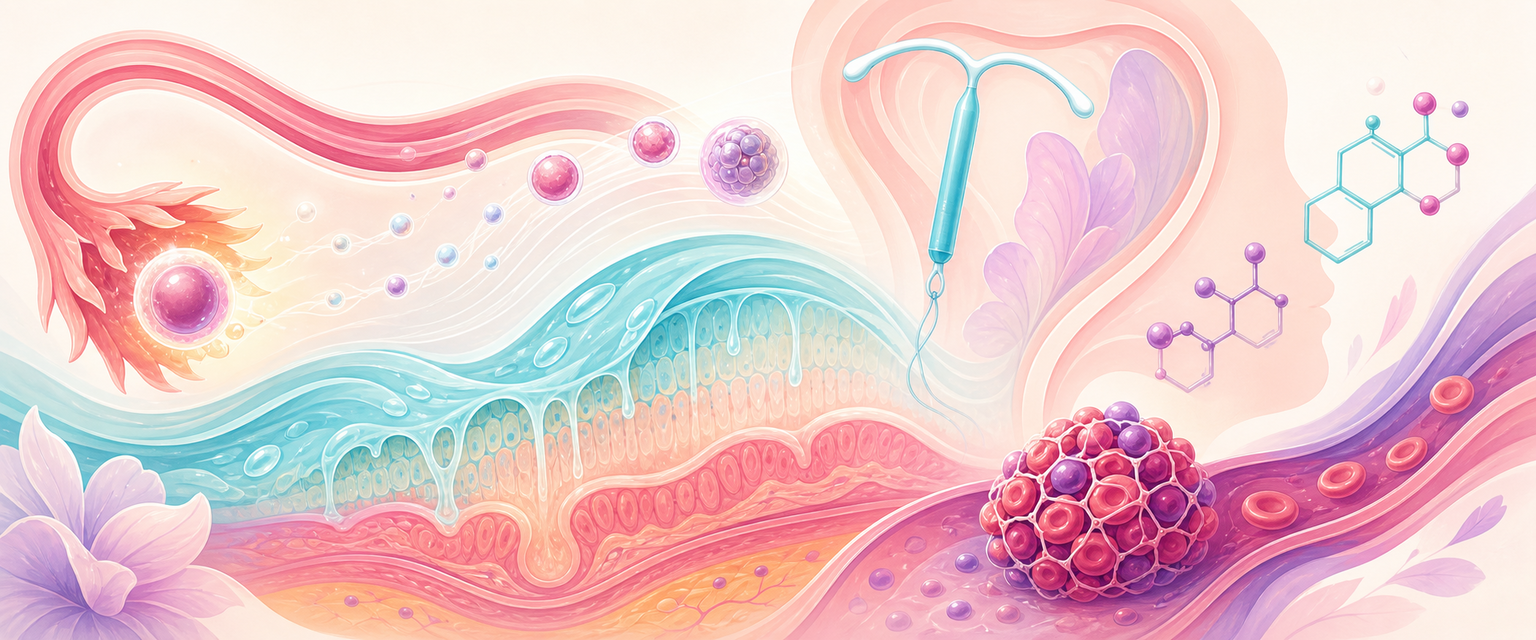
Interactive contraception mechanism chain comparing effects on ovulation, cervical mucus, sperm and endometrium.Contraception Science Prerequisites
Start from one idea: a pregnancy is a chain of physiological events, and a contraceptive works by breaking exactly one link in that chain. Nothing more mysterious is happening. If you can name the links and say which one a method attacks, you can predict that method's efficacy, its side effects, its contraindications and the reason it sometimes fails. That single habit of mind is worth more than any list of brand names, because brands change between countries and clinics while the physiology does not.
Contraception is therefore best understood as applied reproductive biology. Every method interrupts a required step: gamete production, ovulation, sperm entry, sperm survival, fertilisation, tubal transport, endometrial preparation or implantation. This chapter walks up that chain in order, deriving each method's mechanism from the biology that comes before it. We deliberately do not lead with drug names or doses; the Intermediate and Final chapters carry the prescribing detail. Here we build the science the prescribing rests on.
The reproductive chain, written as a sequence so you can point at the broken link, is:
GnRH pulses -> FSH/LH -> follicle selection -> oestradiol rise -> LH surge -> ovulation -> cervical mucus permits sperm -> sperm capacitation in the tract -> fertilisation in the tube -> embryo transport down the tube -> progesterone-shaped secretory endometrium -> implantation
Contraception works by breaking one or more links in that chain. The earlier in the chain a method acts, the more pregnancies it prevents per unit of biological disruption, which is one reason ovulation-suppressing and pre-fertilisation methods tend to be so effective.
| Target | Basic science | Method examples |
|---|---|---|
| Hypothalamus/pituitary | Suppress FSH/LH and LH surge | Combined hormonal contraception, many progestin methods |
| Cervical mucus | Make mucus thick and sperm-hostile | Progestin-only pill, implant, LNG-IUS |
| Endometrium | Create atrophic or asynchronous lining | Progestins, LNG-IUS |
| Tubal/gamete transport | Alter motility and gamete interaction | Emergency contraception, copper IUD effects |
| Sperm viability | Toxic/inflammatory or barrier effects | Copper IUD, condoms |
| Fertilisation exposure | Prevent semen entering upper tract | Condoms, diaphragm, abstinence during fertile window |
| Implantation environment | Intrauterine inflammatory/device effects | Copper IUD, LNG-IUS |
The same science also explains side effects, contraindications and method failure.
Ovulation Control
Ovulation requires follicular development, adequate oestradiol and a positive-feedback LH surge. Combined hormonal contraception suppresses gonadotrophins through negative feedback. Progestins vary in how strongly they suppress ovulation, but many also work at cervix and endometrium.
| Hormonal signal | Normal role | Contraceptive manipulation |
|---|---|---|
| GnRH pulses | Drive LH/FSH release | Negative feedback reduces effective gonadotrophin drive |
| FSH | Recruits and supports follicles | Suppression prevents dominant follicle selection |
| LH surge | Triggers ovulation | Suppression prevents follicle rupture/oocyte release |
| Oestradiol | Endometrial proliferation, positive feedback when sustained | Exogenous oestrogen stabilises endometrium and suppresses FSH |
| Progesterone | Luteal phase, mucus thickening, endometrial secretory change | Progestins thicken mucus, suppress LH, alter endometrium |
The pharmacology principle is feedback. Exogenous hormones do not "replace" the cycle; they create endocrine conditions that prevent the natural cycle from reaching the ovulatory threshold.
Steroid Receptors and Tissue Selectivity
To understand why two progestins can behave so differently, you have to descend one level, from the cycle to the receptor. Oestrogens and progestins are lipophilic steroid hormones: they diffuse across the cell membrane rather than docking on a surface receptor. Inside the cell, members of the steroid-receptor family (oestrogen, progesterone, androgen, glucocorticoid and mineralocorticoid receptors) sit in the cytoplasm complexed with chaperone heat-shock proteins. When the steroid binds, the heat-shock protein dissociates, a nuclear-translocation signal is exposed, and the hormone-receptor complex moves into the nucleus. There its DNA-binding domain (two zinc-finger motifs) docks onto a hormone-response element and switches target genes on or off. The biological effect is therefore a change in gene transcription, which is slow to start and slow to reverse compared with peptide-hormone signalling. A small number of faster, non-genomic membrane effects also exist, but the genomic pathway dominates the contraceptive actions you need to know.
Two consequences fall out of this mechanism. First, because different tissues express different receptor isoforms, co-regulator proteins, metabolising enzymes and transporters, the same circulating steroid produces different effects in hypothalamus, liver, cervix, endometrium, breast, bone and the clotting system. Tissue selectivity is built into the receptor biology, not into the drug. Second, only the free (unbound) fraction of a steroid is biologically active. Most circulating sex steroid is carried bound to sex-hormone-binding globulin (SHBG) and albumin; only a few percent is free. Oestrogen raises hepatic SHBG synthesis, which lowers free androgen, and that is part of why combined methods can improve acne and hirsutism. Progestins with androgenic activity push the opposite way. This free-fraction and SHBG logic is the biochemical thread that links a pill's hormone content to its visible skin, mood and bleeding effects.
| Tissue | Steroid effect relevant to contraception |
|---|---|
| Hypothalamus/pituitary | Negative feedback suppresses FSH/LH |
| Cervix | Progestin makes mucus thick, scant and less penetrable |
| Endometrium | Progestin causes decidualised/atrophic or asynchronous lining |
| Tube | Steroids may alter ciliary and smooth-muscle transport |
| Liver | Oestrogen increases synthesis of several proteins, including clotting-related proteins |
| Breast | Hormonal stimulation can cause tenderness |
| Bone | Oestrogen protects bone; hypo-oestrogenic states can reduce bone density |
| Skin/hair | Androgenic or antiandrogenic progestin effects alter acne/hirsutism |
This is why not all progestins feel the same clinically. Androgenic, antiandrogenic, glucocorticoid-like and mineralocorticoid-like properties differ by molecule.
Cervical Mucus
Cervical mucus changes across the cycle. Under oestrogen, mucus becomes watery, stretchy and sperm-permissive. Under progesterone, it becomes thick, scant and sperm-hostile. Many progestin-only methods rely heavily on this effect.
| Cycle state | Mucus properties | Fertility implication |
|---|---|---|
| Oestrogen-dominant preovulatory phase | Thin, watery, high spinnbarkeit, ferning | Sperm penetration and survival improve |
| Progesterone-dominant luteal phase | Thick, cellular, less penetrable | Sperm entry reduced |
| Progestin contraception | Artificially progesterone-like | Cervical barrier strengthened |
This explains why timing matters for missed progestin-only pills. If the mucus effect weakens, sperm entry can become possible before ovulation suppression is fully restored.
Gamete Transport, Capacitation and Fertilisation
The next link is the journey of the gametes and the moment they meet. Sperm are not simply washed upward; they are actively transported. Mid-cycle, oestrogen-driven mucus aligns into channels that guide motile sperm through the cervix, and low-grade uterine contractions create a slight negative pressure that draws sperm toward the tubes. Viable sperm can reach the upper tract within minutes to a few hours, and capacitated sperm can survive several days in fertile, oestrogen-conditioned mucus. That survival window is the reason a single act of unprotected intercourse days before ovulation can still result in pregnancy, and it is the physiological basis for advising back-up cover for several days after a method fails, not merely on the day of the lapse.
Freshly ejaculated sperm cannot yet fertilise. They must spend hours in the female tract undergoing capacitation: a maturation process that produces hyperactivated motility and changes the sperm surface so it can respond to signals near the oocyte and bind the zona pellucida. When a capacitated sperm reaches the egg, it undergoes the acrosome reaction, releasing lytic enzymes that digest a path through the cumulus and zona. The first sperm to fuse with the oocyte membrane triggers cortical-granule release that hardens the zona and blocks any further sperm entry (the block to polyspermy). Fertilisation normally happens in the ampulla of the fallopian tube, not the uterus.