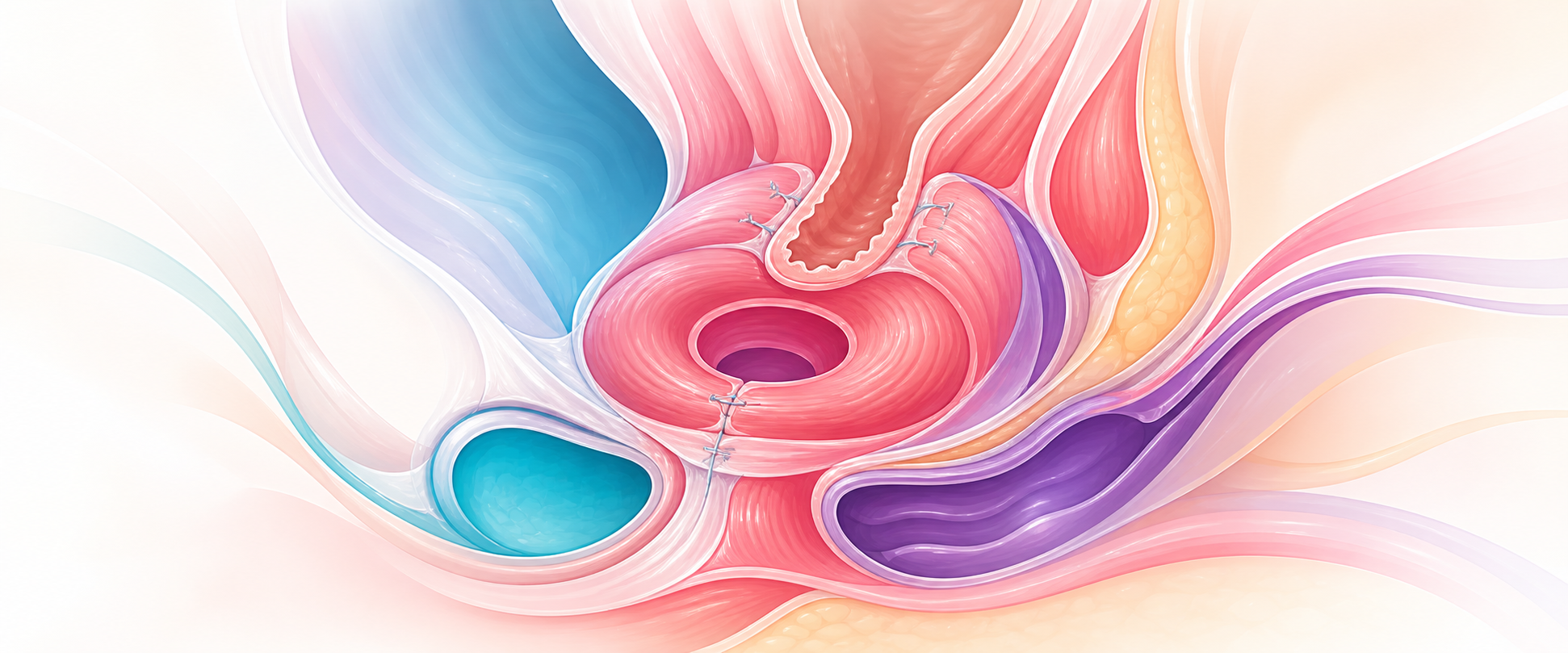
In one line
Obstetric anal sphincter injury is a continence disaster manufactured in the delivery room, so the controllable outcome lives almost entirely in two places — preventing the tear and recognising it the moment it happens — because a sphincter repaired correctly the first time does far better than any salvage, and most post-obstetric faecal incontinence is a missed or mis-repaired OASIS presenting late.
Mechanism & pathophysiology
Continence is a layered system, and faecal incontinence after childbirth almost always means one or more of those layers has failed in a way that maps directly onto a treatment. Four components hold flatus, liquid and solid stool. The internal anal sphincter (IAS) — smooth, involuntary, the terminal continuation of the rectal circular muscle — generates roughly 70–85% of resting anal tone and is the structure that quietly defends against passive soiling and flatal leakage. The external anal sphincter (EAS) — striated, voluntary, tonically active, pudendal-innervated — supplies the squeeze pressure that defers defaecation when the rectum fills. The puborectalis sling pulls the anorectal junction forward into the anorectal angle, a mechanical flap-valve that resists the rise in intra-abdominal pressure. Rectal compliance and sensation allow the rectum to accommodate a bolus and to discriminate flatus from stool. Strip any one component and a different incontinence phenotype appears: lose the IAS and you get passive soiling; lose the EAS and you lose deferment (urge incontinence of stool); blunt rectal sensation and the woman is soiled before she knows the rectum is full.
The groundwork for the injury itself — sphincter anatomy, the Sultan classification, the mechanics of the tear at crowning, the risk-factor list — is assumed here; revise it at the Intermediate OASIS chapter. What the consultant must hold is why obstetric faecal incontinence has two mechanistically distinct sources, because they respond to different operations.
Structural injury is a mechanical defect in the muscle ring — the torn sphincter of an acute OASIS, or the residual defect of one that healed badly. This is the lesion that endoanal ultrasound shows and that a sphincteroplasty can, in principle, close. Neuropathic injury is denervation of an anatomically intact sphincter, classically a pudendal neuropathy from stretch and compression during a prolonged, obstructed or instrumental second stage (and compounded over a lifetime by repeated vaginal delivery and chronic straining). The two coexist far more often than either occurs alone, which is the single most important pathophysiological fact for prognosis: a woman with a "successful" anatomical sphincter repair who still leaks usually has an unrecognised neuropathic component that no further surgery will fix. It also explains the cruel natural history of secondary sphincteroplasty — early results are good, then continence decays over five to ten years as an ageing, partly denervated muscle fatigues.
Occult OASIS is the third mechanistic strand and the reason endoanal ultrasound matters. A proportion of women who are recorded as having an intact perineum or a second-degree tear in fact have a sphincter defect demonstrable on imaging — an injury that was real at delivery but never seen, either because the rectal examination was never done or because the defect was sub-clinical at the time. These occult defects are a major contributor to the prevalence of faecal incontinence in parous women presenting years later, and they reframe the delivery-room examination from a formality into the primary preventive act of the whole topic.
A second mechanism deserves explicit attention because it changes the operation: the posterior compartment does not begin and end at the sphincter. The same delivery forces that tear the sphincter also stretch and disrupt the rectovaginal septum and perineal body, and a deficient perineal body — a foreshortened, attenuated central tendon — leaves the anorectum poorly supported even when the sphincter ring is intact. Clinically this presents as a combination of obstructed defaecation, a sensation of incomplete emptying, a posterior vaginal bulge (rectocele) and, on a background of sphincter weakness, frank incontinence. The consultant point is that "faecal incontinence after childbirth" is rarely a pure sphincter problem; it is frequently a compartment problem in which sphincter injury, perineal-body loss and rectal-wall prolapse coexist, and a repair that addresses only the sphincter while ignoring a deficient perineal body or an obstructing rectocele will under-deliver. This is why the posterior-compartment assessment — perineal-body length, evidence of rectocele or rectal intussusception, and defaecatory symptoms — belongs inside the faecal-incontinence work-up rather than alongside it.
The mechanistic synthesis that should drive every later decision is therefore a triage by which layer has failed: a structural EAS/IAS defect (sphincteroplasty-amenable, ultrasound-visible), a neuropathic but anatomically intact sphincter (better served by neuromodulation than by the knife), a deficient perineal body or rectocele (a reconstructive rather than a sphincter problem), and the very common situation in which several of these overlap. Reasoning back from the failed layer to the operation is what separates a durable result from a disappointing one.
Assessment
The assessment splits cleanly into two settings — the woman on the delivery bed minutes after birth, and the woman in clinic months or years later — and the consultant errors differ in each.
At delivery, every vaginal birth ends with a systematic perineal and digital rectal examination, not only the ones that look traumatic. The injury is missed when the examiner stops at the visible vaginal tear. With adequate analgesia and lighting:
- Inspect the whole perineum, vagina and the apex of any tear or episiotomy.
- Perform a per-rectum examination — a finger in the anal canal, a thumb in the vagina (or direct visualisation), palpating the sphincter while the woman squeezes if the block allows. Feel for the gap or "torn drawstring" of the EAS and the paler, firmer IAS beneath the pink mucosa.
- Grade precisely by the Sultan/RCOG system — 3a (<50% EAS thickness), 3b (>50% EAS), 3c (EAS and IAS torn), fourth-degree (EAS + IAS + anorectal mucosa) — because the grade drives the repair and the counselling.
- Look separately for a buttonhole rectal tear with an apparently intact sphincter, which predisposes to fistula and is repaired in its own right.
The commonest and most expensive assessment failures are not exotic: a 3a called a second-degree tear, and an unrecognised IAS injury inside a tear that was identified as third-degree. Both are downgrades of a real injury, and both surface later as incontinence.
In the symptomatic woman later, the assessment is the colorectal–urogynaecology one:
- A structured continence history that quantifies the problem and separates the phenotypes — passive soiling versus urge incontinence, flatus versus liquid versus solid, pad use, nocturnal leakage, the effect on work and sexual function. Use a validated severity score — the St Mark's (Vaizey) or Cleveland Clinic (Wexner) score — both to grade severity and to give an objective baseline against which any intervention is measured.
- Endoanal ultrasound is the reference standard for demonstrating a structural sphincter defect and for distinguishing it from an intact-but-denervated sphincter — the structural-versus-neuropathic split that decides whether surgery is even on the table. A woman with intractable incontinence and a normal sphincter on imaging will not be helped by a sphincteroplasty.
- Anorectal manometry quantifies resting pressure (IAS function) and squeeze pressure (EAS function), and pudendal nerve terminal motor latency, where available, probes the neuropathic component. These are specialist, tertiary-level investigations in the SA context; they are not needed to recognise an acute OASIS, which stands entirely on the clinical examination.
- Defaecating proctography or dynamic MRI is reserved for the woman whose symptoms point to the posterior compartment — obstructed defaecation, incomplete emptying, a vaginal bulge — to demonstrate a rectocele, rectal intussusception or perineal descent, because these change the operation from a sphincter repair to a reconstruction. They are not part of the routine incontinence work-up and are tertiary investigations.
The interpretation, not the list, is the consultant skill. Endoanal ultrasound that shows an intact ring in a woman with intractable incontinence redirects the plan away from surgery and towards neuromodulation; manometry that shows a low resting pressure with a preserved squeeze localises the problem to the IAS and to passive soiling; a normal squeeze pressure with severe urge incontinence points to rectal rather than sphincter pathology. The investigations are valuable precisely because each one excludes an operation that would otherwise have been offered in error.
Management
Organise the response immediate → ongoing → long-term, and recognise that the single decision with the largest effect on the woman's life is made in the first hour: get the primary repair right, in theatre, by a trained operator, the first time.
Immediate — primary OASIS repair
The repair is not a haemorrhagic emergency, but it is an environment-critical and technique-critical procedure, and the first action when an OASIS is recognised on a labour ward is to stop and escalate.
- Setting and anaesthesia. Repair in theatre, under regional or general anaesthesia, with good lighting and an assistant — not on the delivery bed under a lamp. Adequate relaxation is what allows the retracted EAS ends to be retrieved and approximated.
- Order of repair, deep to superficial. Anorectal mucosa → IAS → EAS → perineal muscle → skin. For a fourth-degree tear, the anorectal mucosa is repaired with a fine continuous or interrupted absorbable suture, knots kept out of the lumen. The IAS is identified as the pale structure and repaired separately by end-to-end approximation with interrupted sutures — explicitly finding and repairing the IAS is the quality step most often skipped, and the one that most determines whether passive soiling is the outcome.
- EAS technique — overlap versus end-to-end. For a full-thickness EAS tear (3b, 3c, fourth-degree) the muscle may be repaired by overlapping the torn ends or by end-to-end approximation. A 3a (partial-thickness) tear is repaired end-to-end. The evidence (developed below) does not establish one full-thickness technique as clearly superior in practised hands, so the operator uses the method they are trained and competent in; what is not acceptable is repairing in a way the operator cannot do well.
- Suture material. A monofilament such as polydioxanone (or a braided absorbable) is used for the sphincter, with knots buried beneath the superficial perineal muscles to reduce suture-migration discomfort.
- Antibiotics and laxatives. Broad-spectrum cover with anaerobic activity at the time of repair reduces wound infection and breakdown — the events that precipitate breakdown and fistula. A course of an osmotic/stool-softening laxative (lactulose) with avoidance of constipating agents protects the fresh repair from the first hard stool. Regular simple analgesia; avoid constipating opioids where they can be avoided. Document grade, technique, suture and operator.
Ongoing — early follow-up and the symptomatic woman
- Catheterise as needed and watch for urinary retention; refer for pelvic-floor muscle training.
- Review at roughly 6–12 weeks in a dedicated perineal/continence service where one exists, with a structured continence enquiry and a severity score. Persistent symptoms, or a woman contemplating another vaginal birth, are the trigger for endoanal ultrasound and anorectal manometry in a specialist setting.
For the woman with established faecal incontinence — whether after a missed OASIS, a failed repair, or an occult defect — management is a deliberate ladder from least to most invasive, and most women are controlled without surgery:
- Conservative first, and it is genuinely effective. Dietary modification and bowel-habit regulation (managing both loose stool and the leakage that follows incomplete evacuation), with loperamide titrated to firm the stool and raise resting tone, controls a large fraction of patients. Loperamide is started low and titrated, including pre-emptive dosing before situations the woman fears.
- Biofeedback-augmented pelvic-floor muscle training is the structured rehabilitation step for those not controlled by simple measures, improving squeeze strength, coordination and rectal-sensory discrimination.
- Sacral neuromodulation (SNM) is the established second-line therapy when conservative management fails, and crucially it is not contingent on an intact sphincter — it benefits both structural and neuropathic incontinence and has displaced sphincteroplasty as the usual next step for many women. A test phase (percutaneous nerve evaluation) selects responders before permanent implantation.
- Secondary (delayed) sphincteroplasty — overlapping repair of a persistent structural EAS defect — is offered to the selected woman with a demonstrated defect, the right symptom profile and a manometrically and neurologically favourable sphincter. Its limitation is the natural history above: good early continence that decays over years as the partly denervated muscle fatigues, which is exactly why an unrecognised neuropathic component must be sought before promising a durable result.
- End-stage options — neosphincter procedures, antegrade continence enema, or a defunctioning colostomy for the woman whose incontinence is intractable and who is failed by everything else — are tertiary, last-resort, quality-of-life surgery, but a well-counselled stoma can be liberating for a housebound woman and should not be withheld out of squeamishness.
Long-term — prevention and the subsequent pregnancy
The most consequential long-term management is the next delivery, and prevention is the lever that closes the whole loop.
Prevention at the index birth is a bundle, not a single act: controlled, slow delivery of the head with manual perineal protection at crowning; a correctly angled mediolateral episiotomy in the high-risk situation (particularly instrumental delivery in a nullipara) — angled to land at roughly 45° from the midline after delivery, which means cutting at around 60° when the perineum is distended, because a shallower cut migrates dangerously close to the midline; warm perineal compresses in the second stage; and the systematic post-birth rectal examination that converts a missed injury into a recognised one. Routine (as opposed to selective) episiotomy is not protective and is not recommended.
Counselling for the subsequent delivery turns on the woman's current state, not the historical grade alone. A woman with a previous OASIS who is asymptomatic with normal endoanal ultrasound and manometry may be offered a subsequent vaginal birth. A woman who is symptomatic, or who has an abnormal sphincter on imaging or manometry, should be counselled toward an elective caesarean to protect what continence remains, with shared decision-making and a documented discussion — because a second sphincter injury on a compromised perineum can be the event that tips her into lifelong incontinence. The honest caveat is that caesarean protects the sphincter but not the pelvic floor wholesale: it does not abolish the neuropathic stretch already sustained, nor prevent future prolapse, so it is offered as continence protection for a defined indication rather than as a guarantee.
The South African layer
The realities of where SA women give birth reshape every part of this. A large share of normal vaginal births occur at district hospitals and Midwife Obstetric Units without an on-site obstetrician or immediate theatre access, so the bottleneck is not repair technique but recognition and referral. The single highest-yield intervention for the SA service is therefore training every accoucheur — midwives included — to perform the routine post-birth rectal examination and to refer a suspected OASIS to a facility that can repair in theatre, rather than closing it as a second-degree tear at the periphery. The repair principle holds regardless of resource level: in theatre, by a trained operator, with antibiotic cover and laxatives, then referred for follow-up.
Resource realities then constrain the downstream ladder. Endoanal ultrasound, anorectal manometry and sacral neuromodulation are tertiary, costly and unevenly available, which means the conservative rungs — diet, loperamide (both on the EML), bowel-habit regulation and biofeedback where a physiotherapy service exists — carry proportionally more of the load in SA than in a well-resourced system, and the threshold to refer for specialist surgery is a referral across levels of care, not a clinic decision. A high local HIV seroprevalence raises the stakes on wound healing and infection: ensure antibiotic cover, optimise the woman's ART per current SA HIV guidance, and watch the repair more closely for breakdown. Recurrent or missed injuries contributing to maternal morbidity feed the Saving Mothers / NCCEMD avoidable-morbidity narrative even though OASIS is not itself a direct cause of maternal death.
Guidelines compared
| Body | Document | Position on the points that matter |
|---|---|---|
| RCOG | Green-top Guideline No. 29 (3rd ed, 2015; 4th in development) | Sultan classification; repair in theatre under regional/general anaesthesia; identify and repair the IAS separately; overlap or end-to-end for full-thickness EAS (operator competence decides), end-to-end for 3a; broad-spectrum antibiotics + laxatives; endoanal ultrasound/manometry and CS counselling for the symptomatic/abnormal subsequent pregnancy. |
| NICE | NG235 (intrapartum care) + CG49 (faecal incontinence in adults) | NG235 covers perineal/episiotomy care and post-birth assessment; CG49 frames the symptomatic woman as a stepped pathway — baseline assessment → conservative (diet, antidiarrhoeals, bowel habit, pelvic-floor/biofeedback) → specialist surgery and SNM. CG49 (2007, reviewed 2018) remains current. |
| SA NDoH | National Integrated Maternal and Perinatal Care Guideline (2024) | SA source of truth for intrapartum/perineal care and levels of care; aligns local repair protocols and defines where a district MOU must refer rather than repair. |
Where they genuinely diverge is less in the what than in the where. The RCOG model assumes an obstetrician and a theatre are available; the deliverable SA question is which births happen at a level that can recognise and repair an OASIS, and which must recognise and refer. NICE CG49's contribution is the orderly second-line ladder for the woman who presents late — the part of the topic the obstetric guidelines barely touch.
The evidence & the controversy
Three threads define current practice, and each has a controversy a consultant should be able to argue.
Prevention works, and the size of the effect is honestly modest. The OASI Care Bundle stepped-wedge study reduced the OASI rate from 3.3% to 3.0% (adjusted OR 0.80) across 16 units and 55,060 births without raising caesarean or episiotomy rates — a real, reproducible, low-cost gain achieved by training and discipline rather than technology. The controversy is twofold: the certainty of the evidence is low (a before-after QI design, not a randomised trial), and a documented rise in recorded OASIS over the 2000s was driven substantially by improved detection rather than worsening obstetrics, so a unit that suddenly examines every perineum will see its rate climb before any bundle pulls it down. The mature reading is that the same intervention that prevents some tears also finds the ones that were always being missed — and finding them is itself a benefit, because a recognised injury is a repairable one.
The episiotomy-angle evidence is unusually mechanistic and unusually actionable. Eogan's case-control work quantified what had been intuition: a 50% relative reduction in third-degree-tear risk for every ~6° the mediolateral cut is angled away from the perineal midline, with cases cut at a mean 30° and controls at 38°. Kalis then showed that a 60° incision on a distended perineum relaxes to ~45° after delivery — which is why "aim for 60° at crowning" became the bundle's number. The live controversy is whether a hand-held judgement of 60° is reliable, which is what spawned fixed-angle devices (Episcissors-60); the trial evidence for those devices is small and low-quality, so the defensible position is that the target angle is well-supported while the device is not yet proven necessary.
For the established injury, the centre of gravity has moved away from the knife. The pivotal appraisal point on primary repair is that the Cochrane comparison of overlap versus end-to-end EAS repair found no clear overall difference (3 trials, 279 women), with a signal favouring overlap for faecal urgency and symptom deterioration at 12 months but an explicit caveat that operator experience — not technique — was the uncontrolled variable. The clinical translation is "do well the repair you can do well," not "overlap is superior." For secondary management, the rise of sacral neuromodulation is the genuine shift: long-term cohorts show ≥50% improvement maintained in around three-quarters of women with active devices (with benefit lost when the device is switched off, confirming it is the stimulation doing the work), and because SNM helps neuropathic as well as structural incontinence it has overtaken delayed sphincteroplasty as the usual next step. The controversy worth naming in a resource-stratified service is access: SNM hardware and endoanal-ultrasound-led selection are tertiary, costly and unevenly available in SA, so the honest plan names the evidence-based ladder and states which rungs a given patient can actually reach.
A fourth thread is the slow reframing of secondary sphincteroplasty itself. For two decades a demonstrated EAS defect in a symptomatic woman led almost reflexively to overlapping sphincteroplasty, and the early continence results were genuinely good. The accumulated long-term data then exposed the problem: continence after delayed sphincteroplasty deteriorates over five to ten years, so a procedure that looks like a cure at one year disappoints at a decade — the natural history of operating on a muscle that is both partly denervated and ageing. The contemporary position is not that sphincteroplasty is obsolete (it remains the right operation for the carefully selected woman with a clear structural defect, good nerve function and the relevant symptom pattern) but that it has lost its automatic primacy: sacral neuromodulation, which helps the neuropathic component that sphincteroplasty cannot touch and which can be trialled reversibly before commitment, has become the more frequent next step. Naming both, and the basis for choosing between them in the individual woman, is what a defensible answer does.
A topical thread sits underneath all of this: the medicolegal weight of OASIS. The injury is one of the most litigated events in obstetrics precisely because it is preventable and detectable, and a missed third-degree tear closed as a second-degree tear is a documentation as much as a clinical failure. The defensible practice — examine every perineum, grade precisely, repair in theatre, document grade, technique, suture and operator — is also the legally defensible one, and in a service where a missed injury may not surface until the woman returns months later to a different clinician, the contemporaneous record of a competent examination and repair is the only thing that distinguishes a recognised-and-treated complication from an alleged failure of care.
Landmark trials & key evidence
| Trial (year) | Question | Key finding | What it changed |
|---|---|---|---|
| Fernando — Cochrane (2006) | Overlap vs end-to-end primary EAS repair after OASIS | No clear overall difference (3 RCTs, 279 women); overlap with lower faecal urgency (RR 0.12, 95% CI 0.02–0.86) and less symptom deterioration at 12 months, but surgeon experience uncontrolled | Established that technique is not the decisive variable — operator competence is; "do well the repair you can do well" |
| Gurol-Urganci — OASI Care Bundle (2021) | Does a 4-element care bundle reduce OASI rates? | OASI 3.3% → 3.0% (adjusted OR 0.80, 95% CI 0.65–0.98) across 16 units, 55,060 births; no rise in CS or episiotomy | Made the prevention bundle (information, manual protection, 60° episiotomy, post-birth PR exam) standard practice |
| Eogan (2006) | Does the angle of mediolateral episiotomy affect sphincter injury? | 50% relative reduction in 3rd-degree-tear risk per ~6° away from the midline (cases 30° vs controls 38°) | Quantified that steeper mediolateral angles protect the sphincter — the mechanistic basis for the 60° rule |
| Kalis (2011) | What suture angle results from a 60° incision? | 60° incision → 45° at repair → 48° at 6 months; low sphincter-injury/incontinence rate | Set "cut at ~60° at crowning to land near 45°" as the operational target |
| Martin — long-term SNM (2024) | Durability of sacral neuromodulation for faecal incontinence (>5 yr) | ≥50% improvement in 77% of women with active devices; 44% fully continent; benefit lost on device inactivation | Confirmed SNM's long-term efficacy and stimulation-dependence; supports SNM as durable second-line for structural and neuropathic incontinence |
| Noblett & Crowder (2021) | Contemporary role and technique of sacral neuromodulation | SNM is a guideline-recommended therapy (AUA, ASCRS) for faecal incontinence with >20 yr of data | Positioned SNM as an established, recommended second-line therapy |
Exam traps & red flags
- Skipping the per-rectum examination after a vaginal birth. The cardinal error and the root of most late faecal incontinence — every vaginal birth gets a rectal examination, not only the ones that look traumatic.
- Downgrading the injury. Calling a 3a a second-degree tear, or failing to identify and separately repair the IAS within a recognised third-degree tear — the IAS is the layer most often overlooked, and its loss is what produces passive soiling.
- Missing a buttonhole rectal tear with an apparently intact sphincter — a setup for rectovaginal fistula.
- Repairing on the delivery bed under poor light and analgesia rather than in theatre — inadequate approximation, breakdown, and a salvage problem created where there need not have been one.
- A midline episiotomy, or a mediolateral cut at too shallow an angle. A midline cut propagates to the sphincter; a mediolateral cut at ~30° is barely better than midline once it migrates — aim for ~60° at crowning.
- Constipating the post-repair patient (opioids without laxatives, omitting stool softeners) — straining disrupts a fresh repair.
- Promising a durable result from secondary sphincteroplasty without excluding neuropathy. Continence after delayed sphincteroplasty decays over years, and an unrecognised neuropathic component means surgery on the structural defect will disappoint — image and assess nerve function first.
- Reaching for surgery before the conservative ladder. Most established faecal incontinence is controlled by diet, loperamide and biofeedback; offering a sphincteroplasty or SNM to a woman who has not had a proper conservative trial is premature.
- Defaulting to sphincteroplasty when there is no demonstrated structural defect. Intractable incontinence with a normal sphincter on imaging is not a surgical sphincter problem — SNM, which also helps neuropathic incontinence, is the better-evidenced route.
- Failing to counsel and document the subsequent-delivery plan, leaving the next accoucheur without a record of a high-risk perineum and a symptomatic woman without the elective-caesarean conversation she was owed.
Evidence anchors
- Fernando et al. — Methods of repair for obstetric anal sphincter injury (Cochrane, 2006)
- Gurol-Urganci et al. — OASI Care Bundle stepped-wedge multicentre study, BJOG 2021
- Eogan et al. — Does the angle of episiotomy affect anal sphincter injury? BJOG 2006
- Kalis et al. — Evaluation of the incision angle of mediolateral episiotomy at 60°, Int J Gynaecol Obstet 2011
- Martin et al. — Long-term outcomes of sacral neuromodulation for faecal incontinence, Dis Colon Rectum 2024
- Noblett & Crowder — Neuromodulation, Obstet Gynecol Clin North Am 2021
- RCOG Green-top Guideline No. 29 — Third- and Fourth-degree Perineal Tears (OASIS)
- NICE CG49 — Faecal incontinence in adults: management
- SA National Integrated Maternal and Perinatal Care Guideline (NDoH, 2024)
- St Mark's (Vaizey) and Cleveland Clinic (Wexner) faecal-incontinence severity scores — validated symptom-severity tools used in colorectal and urogynaecological practice.
- Sultan/RCOG OASIS classification (3a/3b/3c/fourth-degree) — the depth-based grading adopted by RCOG, NICE and SA practice.
