In one line
Müllerian anomalies are a developmental spectrum from a fundal septum to complete uterovaginal agenesis; the consultant tasks are to separate an obstructive anomaly (an adolescent emergency of trapped menstrual blood) from a reproductive one (recurrent loss or preterm birth), to image the kidneys in every case because the urinary tract shares the embryology, and to resist the single most over-performed operation in the field — hysteroscopic resection of a uterine septum, which the only randomised trial failed to show improves live birth.
Mechanism & pathophysiology
The female genital tract is built by three processes that fail independently, and which anomaly a woman has is read off which process failed.
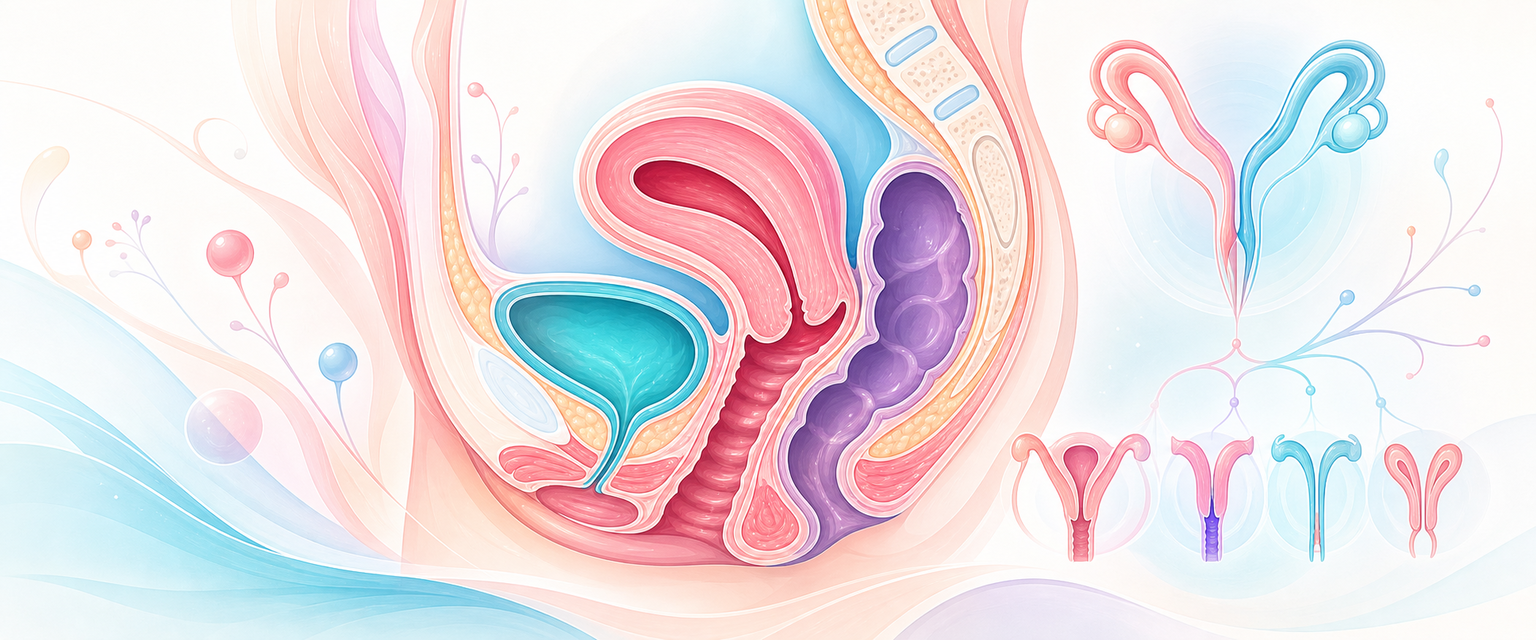
The paired paramesonephric (Müllerian) ducts form alongside the mesonephric (Wolffian) ducts on the urogenital ridge. In the genetic female, the absence of anti-Müllerian hormone lets the Müllerian ducts persist while the Wolffian ducts regress. Each duct elongates caudally, the two fuse in the midline to form the uterus, cervix and upper vagina, and the intervening septum is then resorbed to leave a single cavity. The lower vagina has a separate origin: it canalises from the urogenital sinus, and the sinovaginal bulbs meet the descending Müllerian tissue at the vaginal plate, which then hollows out. Three sequential steps — formation, fusion, resorption — and a failure at each produces a recognisable lesion:
- Agenesis/hypoplasia (formation fails). One duct fails to form (a true unicornuate uterus, sometimes with a rudimentary contralateral horn) or both fail (Müllerian aplasia — the uterovaginal component of MRKH, Mayer–Rokitansky–Küster–Hauser syndrome). The ovaries, derived from the genital ridge rather than the ducts, are unaffected — which is why an MRKH patient has normal pubertal development and normal endocrine function with an absent uterus and a blind or absent vagina.
- Fusion failure. The two horns never come together: a complete failure gives uterus didelphys (two cervices, often a longitudinal vaginal septum); a partial one gives a bicornuate uterus (two horns sharing a single cervix). The defining feature is an externally cleft fundus — fusion was the step that failed.
- Resorption failure. Fusion succeeded but the midline septum was never removed, leaving a septate uterus with a smooth, intact external fundal contour and a divided cavity. This is the commonest anomaly and the one with the worst miscarriage record, and the septum itself — relatively avascular, fibromuscular, a poor implantation surface — is what drives the reproductive harm.
The single most important corollary follows from the duct's neighbour. The mesonephric (Wolffian) duct directs ureteric budding and metanephric induction, so a Müllerian malformation is frequently accompanied by a urinary-tract one — most classically unilateral renal agenesis on the same side as the obstructed or absent Müllerian structure. In a Chinese tertiary series of 444 reproductive-tract anomalies, extragenital malformations accompanied 43.5%, the urinary tract was involved in 30.6%, and renal agenesis on the obstructed side was present in 100% of oblique-vaginal-septum (OHVIRA) cases (Su 2024). Imaging the kidneys is therefore not optional thoroughness; it is part of making the diagnosis.
Two mechanistic points separate the consultant from the trainee. First, obstruction is a function of anatomy plus a functioning endometrium. A non-communicating cavity (a rudimentary horn with endometrium, an obstructed hemivagina, an imperforate hymen) is silent until menarche, then fills cyclically — haematometra, haematocolpos, retrograde menstruation and its sequel, endometriosis. The clock starts at menarche, which is why these present in adolescence. Second, a longitudinal vaginal septum or didelphys does not by itself cause subfertility; the harm in unification defects is obstetric — preterm birth and malpresentation from a smaller, less distensible cavity — not a failure to conceive.
The septum's reproductive toxicity is worth understanding at tissue level, because it is the rationale that the randomised data later undercut. The fundal septum is relatively avascular fibromuscular tissue with a thin, poorly vascularised endometrial covering and altered local progesterone receptivity — an implantation surface that supports a pregnancy badly. An embryo implanting on the septum sits on a poor blood supply; the proposed mechanisms for the excess miscarriage are reduced decidual perfusion, distorted cavity geometry and impaired distension. That is a coherent story, and it is exactly why "find a septum, cut a septum" felt self-evidently correct for decades — the lesson of this topic is that a plausible mechanism is not a substitute for a trial.
MRKH itself sits at the formation end as a more specific entity. It is Müllerian aplasia in a 46,XX woman with normal ovarian function, occurring in roughly 1 in 4,500–5,000 female births. Type 1 (isolated) is uterovaginal aplasia alone; type 2 (MURCS association) adds renal, skeletal (especially vertebral/Klippel–Feil) and occasionally cardiac and hearing anomalies — which is why the MRKH workup is never just a pelvic scan but a renal, spinal and cardiac survey. The genetics are heterogeneous and mostly sporadic; no single causative gene explains the majority, so counselling is about phenotype and associated anomalies rather than a clean Mendelian recurrence risk.
Assessment
The presentation tells you which arm of the spectrum you are in before any imaging.
- The obstructed adolescent. Primary amenorrhoea (or cryptomenorrhoea — cyclical pain with no visible bleeding) with worsening cyclical lower abdominal pain, a perimenstrual mass, sometimes acute urinary retention. An imperforate hymen gives a bulging bluish membrane at the introitus; a transverse vaginal septum or distal atresia gives cyclical pain with a normal-looking introitus and a short or blind vagina — a critical distinction, because incising what looks like a hymen but is a high transverse septum is dangerous. OHVIRA (obstructed hemivagina + ipsilateral renal agenesis, classically with didelphys) gives cyclical pain despite normal menstruation, because one of two systems is obstructed — a paratubal/paravaginal mass with regular periods is OHVIRA until proven otherwise.
- The woman with normal periods and obstetric trouble. Recurrent first-trimester miscarriage, mid-trimester loss, preterm birth or a persistent transverse/oblique lie point to a septate or unification defect found on investigation rather than examination.
- Primary amenorrhoea with normal secondary sexual characteristics. MRKH: normal breast and pubic-hair development (ovaries intact), a blind vaginal dimple, absent or rudimentary uterus on ultrasound. The differential that must be excluded is complete androgen insensitivity syndrome — also amenorrhoea with a blind vagina, but a 46,XY karyotype, absent/scant pubic hair and intra-abdominal testes. A karyotype is mandatory before MRKH is settled; the management, gonadal-cancer risk and counselling diverge completely. This overlaps the disorders-of-sex-development workup covered at disorders-of-sex-development and the pubertal differential at puberty-and-its-disorders.
- The incidental finding. A septate or arcuate uterus found at caesarean, laparoscopy or routine scan in an asymptomatic, normally fertile woman — a finding that frequently needs no intervention, and over-treating it is a recognised harm.
Investigation is led by imaging, and the reference standards are specific:
- 3D transvaginal ultrasound is the practical first-line and, in expert hands, approaches MRI for the septate-versus-bicornuate distinction because the coronal plane shows the fundal contour. It is operator-dependent, which matters in a service where 3D probes and the skill to use them are concentrated in a few centres.
- MRI is the reference standard for the full anatomy: it shows the external fundal contour (the feature that separates septate from bicornuate), the presence and content of a rudimentary horn, the level of a vaginal septum, cervical and vaginal anatomy, and associated renal position. The septate-versus-bicornuate call is the one that changes management most and is the one a 2D scan or hysterosalpingogram (which sees only the cavity, never the external contour) cannot make — an HSG showing two cavities is equally compatible with a septate and a bicornuate uterus.
- Renal tract imaging in every confirmed anomaly — ultrasound at minimum, because of the shared embryology and the 100% renal-agenesis association in OHVIRA.
- Karyotype where MRKH is suspected (to exclude CAIS) and where the phenotype is ambiguous.
The distinction that the whole chapter turns on: the external fundal contour. A smooth, convex or minimally indented fundus over a divided cavity is septate (resorption defect); a deeply cleft fundus (external indentation exceeding ~50% of the wall thickness in the CONUTA scheme) is bicornuate (fusion defect). Treating a bicornuate uterus as a septum — taking a hysteroscope to a fundus that has myometrium between the two cavities — perforates into the peritoneal cavity. The contour, not the cavity, is the safety check.
The septate-versus-bicornuate decision in depth
The two systems quantify the same anatomy differently, and a consultant should be able to state both. CONUTA (ESHRE/ESGE) is the more explicitly geometric: it measures the depth of the fundal indentation against the uterine wall thickness, calls an internal (cavity-side) indentation exceeding 50% with a normal external contour a U2 septate, and an external fundal cleft exceeding 50% a U3 bicorporeal, with the old "arcuate" subsumed into normal/U1 minor deformity. ASRM MAC2021 keeps the categories descriptive but defines septate as a midline fundal indentation depth >1 cm with an angle <90°, and an arcuate/normal variant as a shallower, wider indentation — which is why the same uterus can be "septate" by one system and "arcuate/normal" by the other near the boundary, and why two reports on one woman can disagree. The practical consequence is not academic: because the only intervention (hysteroscopic incision) carries risk and unproven benefit, a borderline lesion should bias towards the conservative label, not away from it. When the imaging is equivocal, the safest reading is the one that does not commit a healthy woman to an operation.
This is also where the rudimentary horn must be characterised precisely, because the words change the operation. A horn is described by two axes: communicating or non-communicating with the main cavity, and with or without functioning endometrium. The dangerous combination is non-communicating with functioning endometrium — it obstructs, accumulates blood, drives endometriosis, and is the classic site of a horn (cornual/interstitial-type) ectopic that can rupture in the second trimester with massive haemorrhage. MRI is the tool that makes this call, and it is the call that decides whether the horn is excised or left.
Management
Sort the spectrum into three management problems, because the answer to each is different: the obstructive emergency, the reproductive anomaly, and agenesis (MRKH).
The obstructive anomaly — relieve the obstruction, but match the operation to the level.
- Imperforate hymen: a simple cruciate or elliptical hymenotomy under anaesthesia drains the haematocolpos; this is the one obstructive lesion that is genuinely straightforward, and it is curative.
- Transverse vaginal septum / distal vaginal atresia: resection and anastomosis, but the level and thickness determine difficulty and the stenosis risk is high — a low thin septum is manageable locally, a high or thick one needs a referral centre with reconstructive expertise. Incising it as if it were a hymen is the classic error.
- OHVIRA: resection (marsupialisation) of the obstructing vaginal septum to drain the obstructed hemivagina; once drained, the duplicated system usually functions, and many women conceive. The non-obstructed side has been menstruating normally throughout.
- Obstructed (non-communicating) rudimentary horn with functioning endometrium: laparoscopic excision of the horn, because it is a source of haematometra, retrograde menstruation/endometriosis, and — the dangerous part — a site for an ectopic pregnancy that can rupture catastrophically in the second trimester. The horn is removed, not drained.
These are generally not surgical emergencies in the sense that they can be planned for the right surgeon and theatre rather than done overnight; the emergency is the missed diagnosis, not the timing of the list (ACOG CO 779, 2019). The exception is acute retention or an unwell patient.
The reproductive anomaly — operate selectively, and only the septum.
- Septate uterus: hysteroscopic septum incision (metroplasty) is the only anomaly with a plausible surgical fix, because the septum is incised (divided so the cavity unifies), not excised, with minimal blood loss and a quick recovery. The decision to do it at all is the genuine controversy — the historical case rested on uncontrolled before-and-after data, and the one randomised trial did not show benefit. A defensible position is to reserve it for women with a clear adverse reproductive history (recurrent miscarriage, mid-trimester loss) after full counselling that the evidence is weak, and to not offer it routinely to an asymptomatic woman or for unexplained infertility alone.
- Bicornuate and didelphys uterus: do not operate to "unify" them. Abdominal metroplasty (Strassman) for a bicornuate uterus is largely historical, carries a real risk of uterine rupture in a subsequent pregnancy, and has no good evidence of benefit. The harm here is obstetric (preterm birth, malpresentation), managed by surveillance — and the role of cervical cerclage is unproven and not routine. A longitudinal vaginal septum is resected only if it obstructs, causes dyspareunia, or obstructs delivery.
- Unicornuate uterus: no reconstructive option; manage as a higher-risk pregnancy with attention to preterm birth and growth. Excise an obstructed rudimentary horn as above; an unobstructed communicating horn without endometrium is generally left.
The obstetric management of an anomalous uterus is where most of the clinical work actually lives, because the majority of these women are diagnosed after they conceive, and reconstruction is rarely the answer. The recurring problems are preterm birth, malpresentation, fetal growth restriction (a smaller or distorted cavity) and, in didelphys/bicornuate uteri, the surprise of a transverse or oblique lie at term. A pragmatic plan: confirm the anomaly and screen the kidneys; counsel that fertility is usually preserved but the pregnancy carries a higher preterm and malpresentation risk; offer serial growth surveillance because the cavity may restrict growth; and have a low threshold for caesarean when the presentation is abnormal at term, which it frequently is. Routine cervical cerclage has no good evidence base in these women and is not justified by the diagnosis alone — reserve it for a genuine, separately diagnosed cervical insufficiency on its own merits, not for the uterine shape. A retained longitudinal vaginal septum can obstruct a vaginal delivery and tear; if a vaginal birth is planned in a woman with didelphys and a vaginal septum, that septum is dealt with antenatally or anticipated intrapartum. The single most useful antenatal act in a known anomaly is to document the presentation serially in the third trimester so the abnormal lie is a planned caesarean rather than an intrapartum emergency.
Agenesis — MRKH. This is a diagnosis with three jobs: create a functional vagina, address fertility, and support a young woman through a major reshaping of her future.
- Vaginal dilation is first-line. Graduated self-dilation (the Frank method, or Frank–Ingram using a bicycle-seat stool) creates a functional neovagina non-surgically in roughly three-quarters of motivated patients, with comparable sexual function to surgery and far less morbidity — which is why every guideline puts it first (ACOG CO 728, 2018). Success depends on readiness and support, so it is started when the young woman is psychologically prepared, not on a fixed birthday.
- Surgical vaginoplasty (Vecchietti — laparoscopic traction; McIndoe — split-skin graft; Davydov — peritoneal pull-through; bowel vaginoplasty) is reserved for dilation failure or where the patient cannot or will not dilate. The choice is centre- and expertise-dependent.
- Fertility. The ovaries work, so the woman's own oocytes are usable: the established route to a genetic child is IVF with a gestational carrier (surrogacy) — which in South Africa is permissible only through a court-confirmed surrogate-motherhood agreement under the Children's Act, a real constraint on access. Uterus transplantation has produced live births internationally but remains experimental and is not available in routine SA practice. Adoption is part of the counselling.
- Psychological support is core treatment, not an add-on. A diagnosis of absent uterus and vagina in adolescence is a profound event; structured psychological support and peer/patient-group linkage materially improve outcomes and dilation success. The diagnosis is frequently delivered to a teenager and her family in a single clinic visit; how it is disclosed — privately, unhurried, with a clear forward plan and a follow-up appointment, not as a list of what is missing — shapes the woman's adjustment for years and is a measurable part of the management, not soft framing.
The ethical and consent texture of MRKH care is genuinely Final-level. Dilation and vaginoplasty in a minor sit at the intersection of best interests, the adolescent's evolving capacity to consent to an intimate intervention, and the temptation to "complete" treatment before the young woman is ready — and the consistent guidance is to wait for readiness, because a neovagina created before a woman is motivated to maintain it stenoses. Timing is led by the patient's psychological preparedness and intention to be sexually active, not by chronological age or parental wish. In the SA context the surrogacy pathway adds a further consent and equity layer: a court-confirmed agreement is required, the costs are largely out of public-sector reach, and a counselling conversation that promises genetic motherhood without naming these barriers is misleading. The honest plan offers dilation now, names surrogacy and adoption as the realistic future routes, is candid that uterus transplantation is experimental and unavailable here, and books the psychological support as a treatment line in its own right.
In the South African service the binding constraints are concrete: MRI and 3D ultrasound (the tools that make the septate-versus-bicornuate call safely) are unevenly distributed, hysteroscopic theatre access is limited, complex reconstructive surgery for high transverse septa and vaginoplasty belongs in tertiary centres, and surrogacy is legally gated. Naming the deliverable plan — refer the complex obstructive and agenesis cases to a tertiary unit, do the imperforate hymen and the straightforward dilation programme locally, and do not improvise a hysteroscopic metroplasty on a fundus you have not imaged in the coronal plane — is the realistic answer.
Guidelines compared
| Body | Classification & stance | Where it diverges |
|---|---|---|
| ASRM (MAC2021) | Nine descriptive categories (agenesis, cervical agenesis, unicornuate, didelphys, bicornuate, septate, longitudinal/transverse vaginal septum, complex). Builds on 1988 AFS; adds cervix/vagina | Retains a clinically familiar, prose-style system; criticised for less precise quantitative thresholds than CONUTA |
| ESHRE/ESGE (CONUTA) | Anatomy-based, lettered/numbered: U0 normal · U1 dysmorphic · U2 septate · U3 bicorporeal · U4 hemi-uterus · U5 aplastic · U6 unclassified, with independent cervical (C) and vaginal (V) coding | Uses an explicit >50% fundal-indentation threshold to separate septate (internal) from bicorporeal (external); criticised for over-diagnosing "septate" and prompting over-treatment |
| ACOG (CO 728 Müllerian agenesis; CO 779 obstructive) | Dilation first-line for MRKH neovagina; obstructive anomalies are generally not emergencies, refer high septa/atresia to expertise centres | Pragmatic management guidance rather than a classification; aligns with dilation-first and selective surgery |
| SA NDoH / tertiary practice | No standalone SA classification; practice follows the above, gated by access (MRI, hysteroscopy, reconstructive surgery) and surrogacy law (Children's Act court approval) | The divergence is resource and legal, not conceptual |
The substantive disagreement is not which letters to use; it is where to draw the line between a septate uterus that warrants discussion of surgery and a normal-variant or arcuate uterus that does not. The CONUTA >50% threshold reclassified many uteri previously called "arcuate" or "subseptate" as U2 septate, and a documented criticism is that this lowers the surgical threshold for a procedure of unproven benefit — the classification debate and the treatment controversy are the same argument in different clothes.
The evidence & the controversy
The reproductive impact of these anomalies is real but unevenly distributed, and the cleanest summary is the Chan 2011 systematic review of 3805 women: canalisation defects (septate/subseptate) carry the worst record — reduced clinical pregnancy (RR 0.86), nearly tripled first-trimester miscarriage (RR 2.89), doubled preterm birth (RR 2.14) and a six-fold malpresentation risk (RR 6.24). Unification defects (unicornuate, bicornuate, didelphys) do not reduce fertility but raise preterm birth (RR 2.97) and malpresentation (RR 3.87). Even the arcuate uterus, long dismissed as a non-entity, was associated with second-trimester miscarriage (RR 2.39). That the septate uterus has the strongest association with loss is precisely what made hysteroscopic metroplasty intuitively attractive.
The controversy is whether cutting the septum changes that outcome. For decades the answer was assumed yes, on the strength of uncontrolled before-and-after series in which a woman with recurrent miscarriage had her septum incised and her next-pregnancy outcomes improved. The flaw is structural: recurrent miscarriage regresses to the mean, most couples eventually carry a pregnancy regardless of intervention, and a before-and-after design cannot separate the operation from the natural history. The first — and so far only — randomised trial, TRUST (Rikken 2021), allocated 80 women with a septate uterus and a poor reproductive history to resection or expectant management and found live birth in 31% vs 35% (RR 0.88, 95% CI 0.47–1.65) — no signal of benefit, and the confidence interval comfortably includes "no effect" in either direction. The honest reading is not "metroplasty has been disproven"; the trial was small, recruitment to a procedure clinicians believed in was hard, and it is underpowered to exclude a modest benefit. But it decisively removes the certainty that justified routine operating, and it shifts the burden of proof: a procedure with surgical risk (perforation, intrauterine adhesions, the small but real possibility of harming a previously functional cavity) now has to justify itself against a trial that failed to find it helps.
The defensible viva position holds three things at once: the association between septate uterus and miscarriage is robust; the causal benefit of incising the septum is unproven and the only RCT was negative; and therefore the procedure is offered, if at all, to a fully counselled woman with a genuine adverse reproductive history rather than performed reflexively on every U2 uterus or for unexplained infertility. The candidate who says "septate uterus, so I'd resect it" has not read the last decade. The candidate who recognises that the classification and treatment controversies are linked — that pushing more uteri into the "septate" box via a 50% threshold manufactures more candidates for an operation that may not work — is reasoning at consultant level.
Two further threads belong here. First, the kidney is part of the diagnosis: the temptation to image only the genital tract and miss the unilateral renal agenesis is a recurring failure, and in OHVIRA the renal agenesis is effectively universal on the obstructed side (Su 2024). Second, the psychological and equity dimension of MRKH is increasingly recognised as central rather than peripheral — fertility via surrogacy is legally and financially out of reach for most SA patients, uterus transplantation is experimental, and a management plan that delivers a neovagina but ignores the loss of genetic motherhood and the legal barriers has done half the job.
Landmark trials & key evidence
| Trial / study (year) | Question | Key finding | What it changed |
|---|---|---|---|
| TRUST (Rikken, 2021) | Hysteroscopic septum resection vs expectant management in septate uterus with poor reproductive history (RCT, n=80) | Live birth 31% (resection) vs 35% (expectant); RR 0.88 (95% CI 0.47–1.65) — no benefit | Removed the certainty behind routine metroplasty; shifted to selective, counselled use |
| Chan (2011) | Reproductive outcomes by anomaly type (systematic review, 3805 women) | Canalisation defects: ↓pregnancy RR 0.86, ↑1st-trimester miscarriage RR 2.89, ↑preterm RR 2.14, ↑malpresentation RR 6.24; unification defects ↑preterm RR 2.97 but no fertility reduction; arcuate ↑2nd-trimester miscarriage RR 2.39 | Quantified which anomalies harm reproduction and how — the evidence base for selective management |
| ASRM MAC2021 (Pfeifer, 2021) | A usable classification including cervix and vagina | Nine descriptive categories extending the 1988 AFS system | Current ASRM standard; descriptive, clinically recognisable |
| ESHRE/ESGE CONUTA (Grimbizis, 2013) | An anatomy-based European classification | U0–U6 main classes with a >50% fundal-indentation threshold for septate vs bicorporeal, independent cervical/vaginal coding | The dominant European system; its threshold drives the over-diagnosis debate |
| Su (2024) | Associated extragenital malformations in 444 reproductive-tract anomalies | Extragenital 43.5%; urinary 30.6%; renal agenesis on the obstructed side 100% in OHVIRA; skeletal 13.5% | Evidence basis for mandatory renal (and spinal) imaging in every anomaly |
| ACOG CO 728 (2018) | Management of Müllerian agenesis (MRKH) | Vaginal dilation first-line; surgery reserved for failure; fertility via gestational carrier | Established dilation-first as the standard of care for MRKH |
Exam traps & red flags
- Resecting every septum. "Septate uterus → metroplasty" ignores the only RCT (TRUST, negative). Metroplasty is selective and counselled, not automatic, and is not indicated for an asymptomatic incidental septum or for unexplained infertility alone.
- Confusing septate with bicornuate on a cavity image. An HSG or 2D scan sees two cavities and cannot tell them apart — only the external fundal contour (MRI or expert 3D ultrasound) distinguishes a resorption defect (smooth fundus, hysteroscopically incisable) from a fusion defect (cleft fundus, where a hysteroscope perforates the peritoneum). Operating on the wrong one is a surgical disaster.
- Forgetting the kidney. Failing to image the urinary tract misses the unilateral renal agenesis that accompanies these anomalies (universal on the obstructed side in OHVIRA) — image the kidneys in every confirmed case.
- Cyclical pain with normal periods read as primary dysmenorrhoea. Regular menstruation does not exclude OHVIRA — one of two systems is obstructed. A paravaginal mass plus normal periods is OHVIRA until proven otherwise.
- Incising a "hymen" that is a high transverse septum. A bulging introital membrane is an imperforate hymen and is safely incised; a normal introitus with cyclical pain and a short vagina is a transverse septum or distal atresia needing imaging and a reconstructive centre — incising blindly is dangerous.
- Missing the obstructed rudimentary horn. A non-communicating horn with functioning endometrium causes haematometra and endometriosis and is a site of catastrophic second-trimester ectopic rupture — it is excised, not observed.
- Settling MRKH without a karyotype. Amenorrhoea with a blind vagina and normal breasts is MRKH or complete androgen insensitivity (46,XY, gonadal-tumour risk) — the karyotype is mandatory before either is accepted.
- Offering surgery before dilation in MRKH. Graduated dilation is first-line and succeeds in most motivated patients; surgical vaginoplasty is for failure, not first contact.
- Treating the vagina and ignoring the future. An MRKH plan that creates a neovagina but does not address fertility (surrogacy, the SA legal pathway), genetic-motherhood loss and psychological support is incomplete.
- Strassman metroplasty / cerclage for a bicornuate uterus. Abdominal unification surgery is largely historical and risks rupture; routine cerclage in unification defects is unproven. The management of unification defects is obstetric surveillance, not reconstruction.
Evidence anchors
- Rikken et al. — TRUST RCT, septum resection vs expectant management, Hum Reprod 2021
- Chan et al. — reproductive outcomes in congenital uterine anomalies (systematic review), Ultrasound Obstet Gynecol 2011
- Pfeifer et al. — ASRM Müllerian Anomalies Classification 2021, Fertil Steril 2021
- Grimbizis et al. — ESHRE/ESGE (CONUTA) consensus classification, Hum Reprod 2013
- Su et al. — concomitant extragenital malformations in reproductive-tract anomalies, Zhonghua Fu Chan Ke Za Zhi 2024
- ACOG Committee Opinion No. 728 — Müllerian Agenesis, Obstet Gynecol 2018 (PMID 29266078)
- ACOG Committee Opinion No. 779 — Management of Acute Obstructive Uterovaginal Anomalies, Obstet Gynecol 2019 (PMID 31135762)
- South Africa — gestational surrogacy is permissible only via a High Court–confirmed surrogate-motherhood agreement under the Children's Act 38 of 2005; renal and spinal imaging form part of the standard anomaly workup in tertiary practice.
